
Last updated October 9, 2026
Full 25-point door and opener safety check with every visit - springs, cables, rollers, tracks, and your LiftMaster or Chamberlain opener included
You get a price before we start. It does not change when the truck arrives.
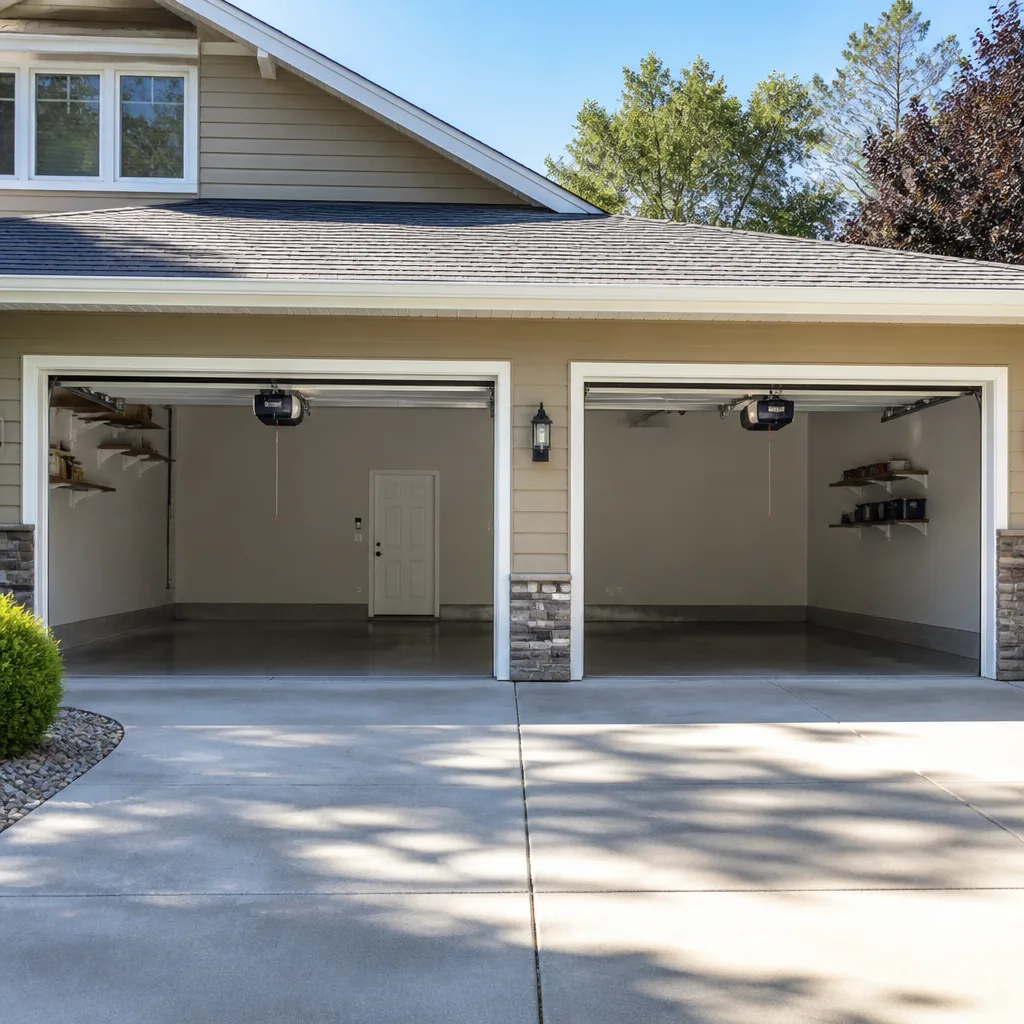
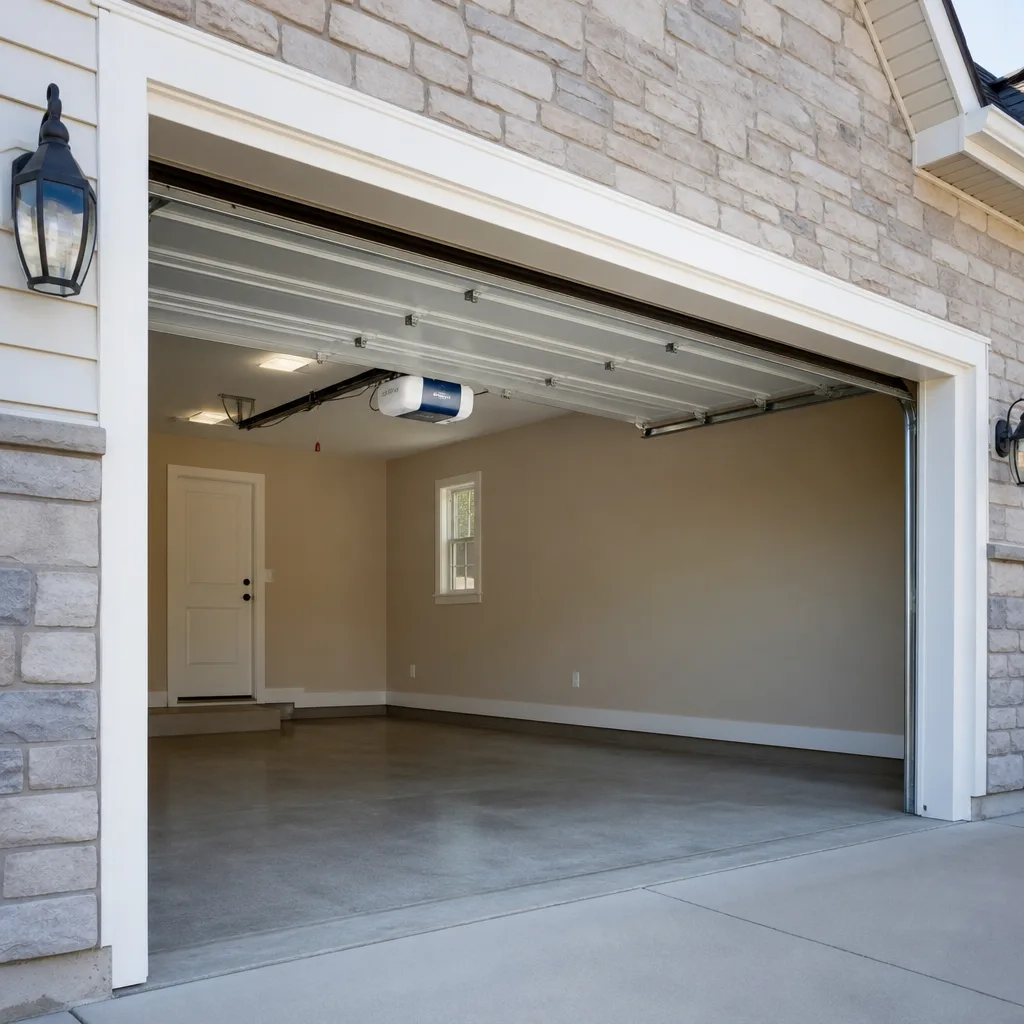
 Before
 After
After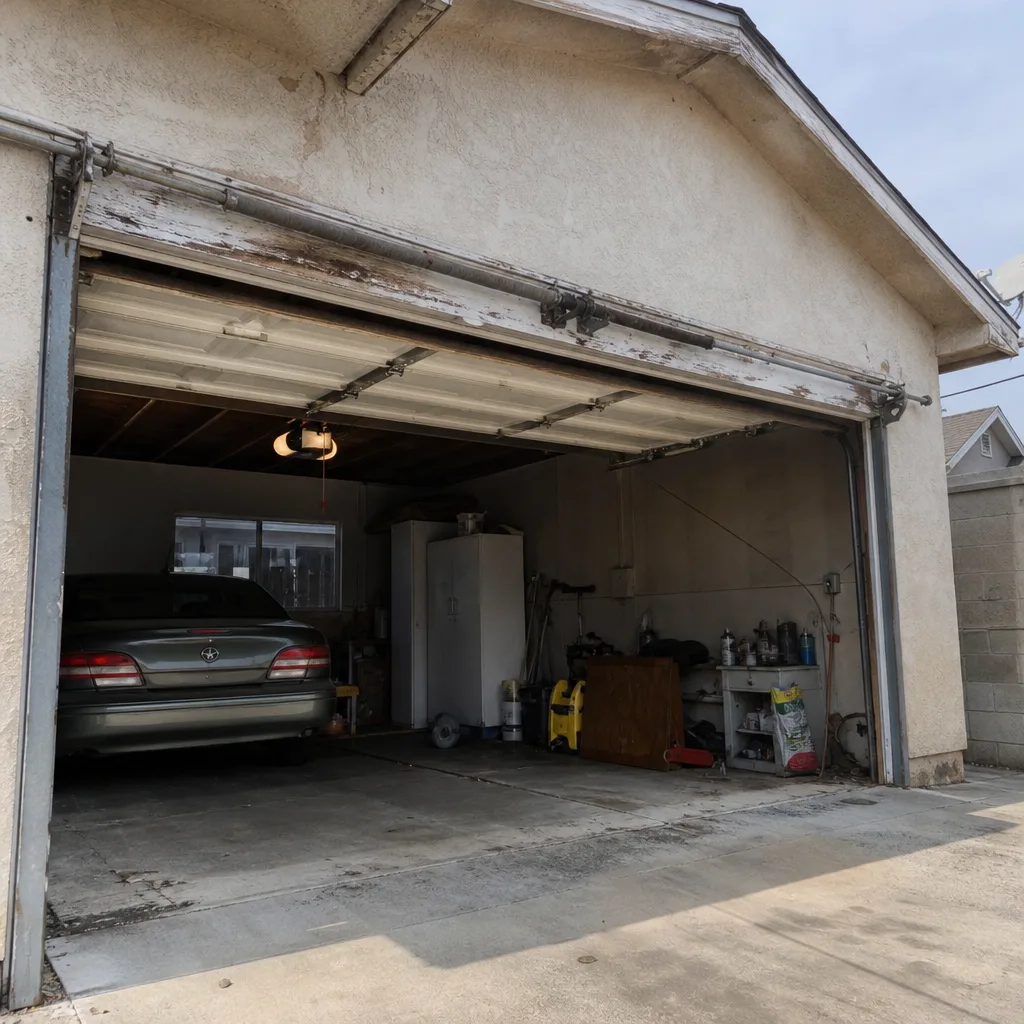 Before
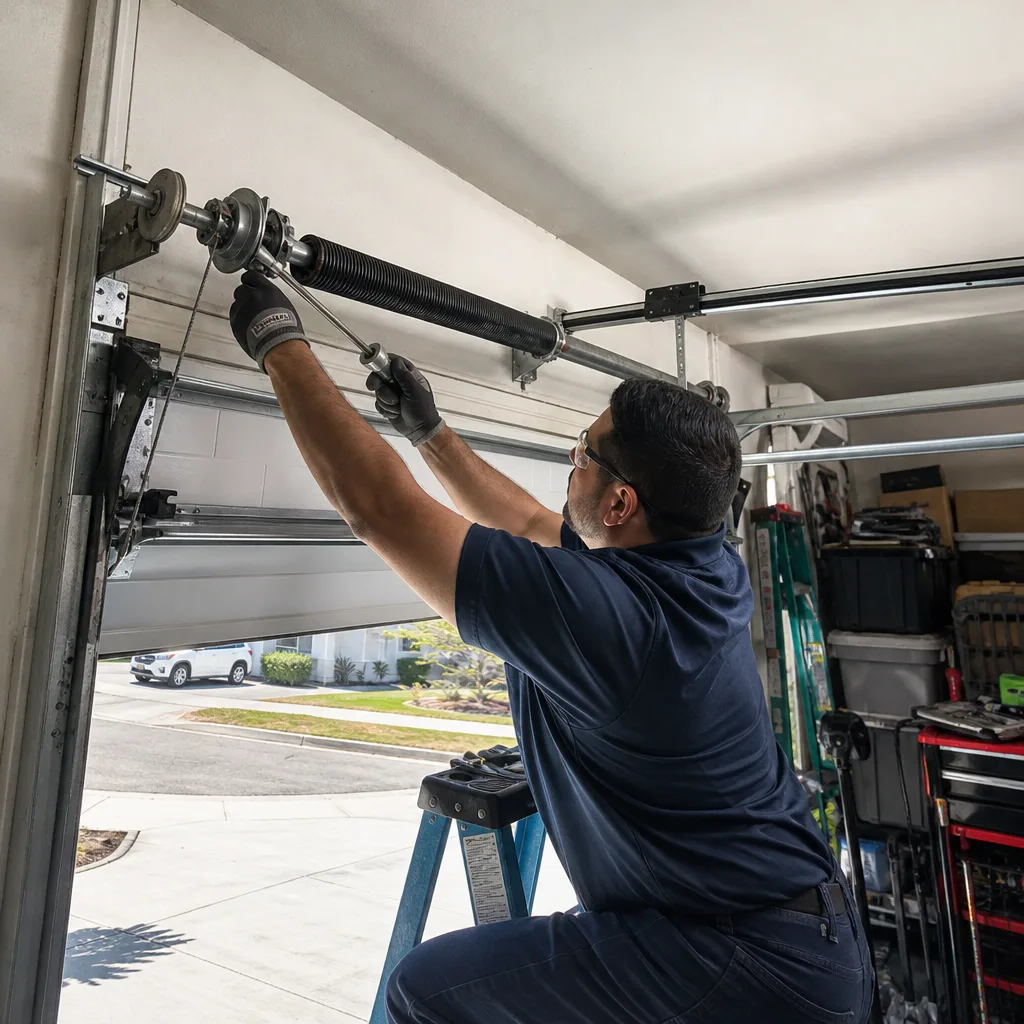 After
After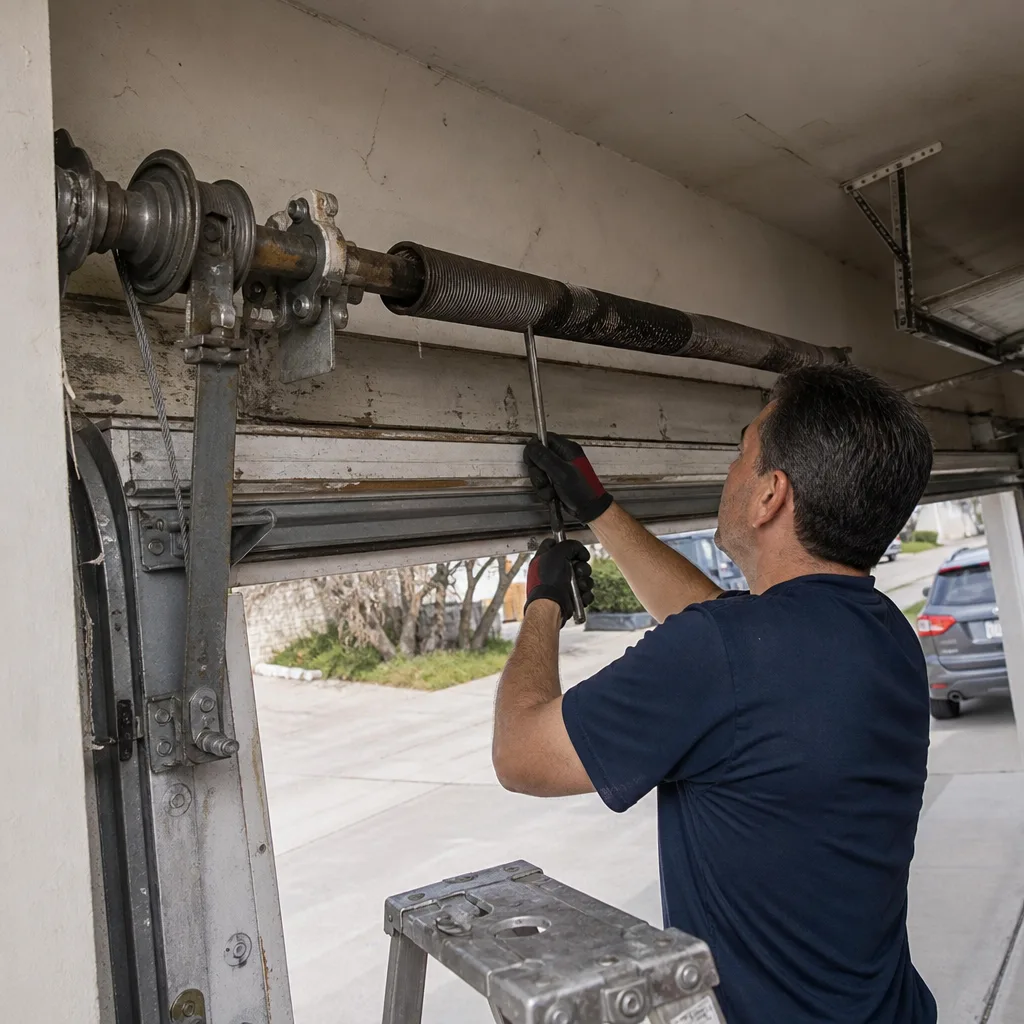 Before
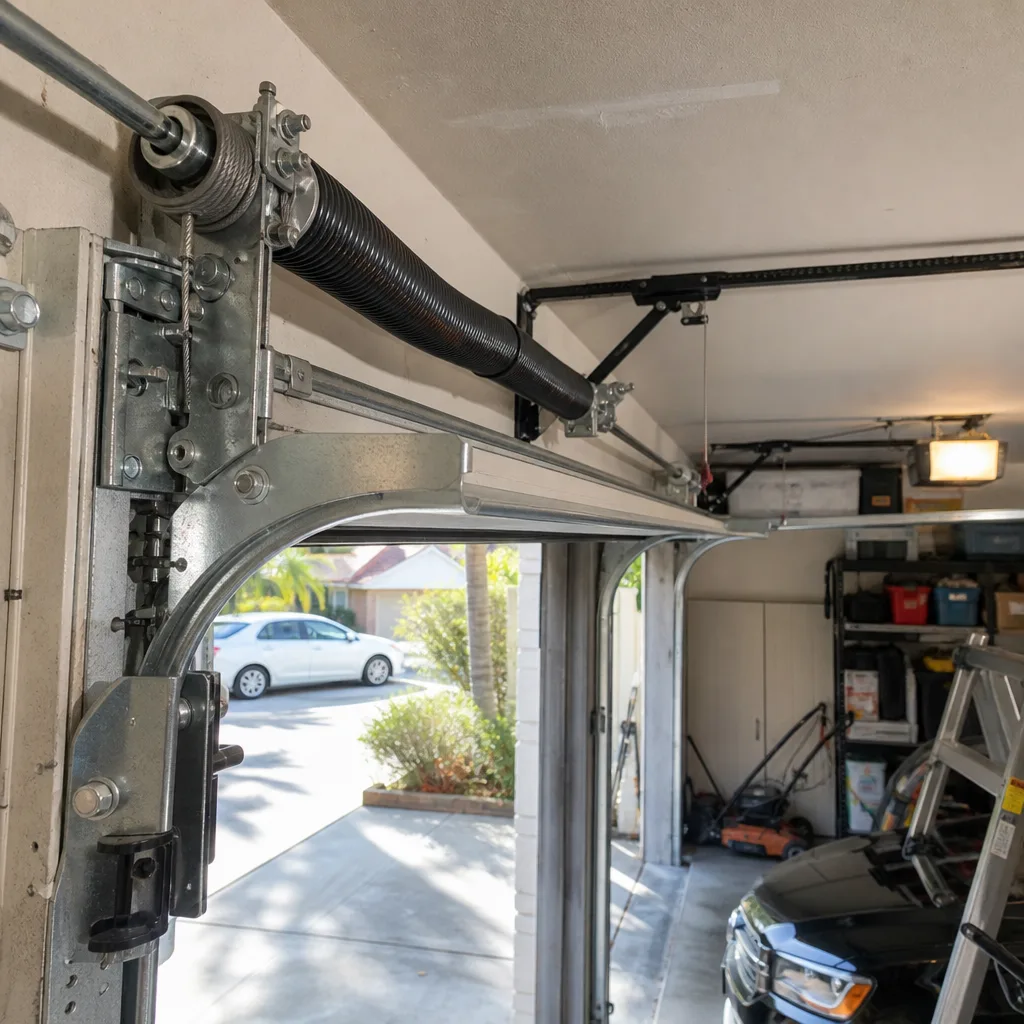 After
AfterGarage Door Installation Troubleshooting: Common Problems and How to Fix Them
A brand-new garage door that reverses before fully closing isn’t defective. It has a limit switch that wasn’t calibrated after installation, which takes about four minutes to fix and is entirely the installer’s responsibility to correct before they leave your driveway. This guide covers the four installation mistakes that cause most new-door problems, how to document them properly, and when to push back on an installer who says “that’s normal.” For homeowners who want to spot trouble before it starts, we’ve also published Garage Door Installation Warning Signs Every Homeowner Should Know. We’ve spent 24 years watching these same issues show up in Los Angeles garages, from Westchester to Sherman Oaks, and they almost always trace back to what happened, or didn’t happen, on installation day.
Quick Answer
Most problems with a newly installed garage door come from four installation errors: a miscalibrated limit switch (door reverses before closing), an unlevel track or unequal spring tension (uneven gap at the floor), misaligned rollers or incorrect track gap (grinding noise), or springs set with insufficient tension for the door’s weight (opener strains and moves the door slowly). All four are correctable, should be covered under our Garage Door Installation services warranty, and are easiest to resolve when you document the symptom before anyone starts adjusting anything.
Table of Contents
- Why a New Door Reverses Before It Fully Closes
- Uneven Gap at the Floor: Track Level and Spring Tension
- Grinding Noise When the Door Moves: Rollers and Track Gap
- Opener Strains But Door Moves Slowly: Spring Tension Problems
- How to Document an Installation Problem Correctly
- Spring Tension: What Installers Set at the End and Why It Matters
- The Track Gap Specification: 1/4 Inch and What It Means
- 365-Day Written Guarantee: Installation vs. Repair Coverage
Why a New Door Reverses Before It Fully Closes
A door that starts closing, hits the floor or gets within an inch or two of it, and then reverses back up is the single most common post-installation complaint we hear in Los Angeles. The cause is almost never a defective motor or a faulty sensor. It’s the limit switch, a small component inside the opener that tells the motor how far the door should travel before stopping. When an installer sets the down limit too aggressively, the door presses against the floor and the opener’s built-in force detection reads that pressure as an obstruction. The safety system kicks in and reverses the door upward.
This is a calibration issue, not a hardware failure. The fix involves adjusting the limit switch so the door stops exactly at the floor without pressing into it. On LiftMaster and Chamberlain openers, this is done through a small dial or button on the motor unit. On Genie models, it’s a similar adjustment on the powerhead. The process takes a few minutes. What matters for you as the homeowner is that this adjustment was the installer’s job to complete before they left your property. A door that reverses on close right after installation means the job wasn’t finished.
Here’s what to check before you call anyone:
- Watch where the door stops. If it touches the floor and then reverses, the down limit is set too far. If it stops two inches above the floor and reverses, the limit is set too short and the door is triggering the safety reversal early.
- Test the door by hand. Pull the emergency release cord and operate the door manually. If it moves smoothly and closes fully by hand, the problem is in the opener’s limit settings, not the door hardware.
- Listen for a clicking sound. Many openers click when the limit switch engages. If you hear the click before the door reaches the floor, that confirms the limit is set incorrectly.
If your opener was installed with your new door and the installer is still in contact with you, this should be a free callback. It was never set correctly. If you’ve already lost faith in the original installer, Garage Door Opener Repair in Grandview covers limit switch calibration and every other opener adjustment, and the price is written down before anyone touches anything.
Uneven Gap at the Floor: Track Level and Spring Tension
When a new garage door sits with one side touching the floor and the other side raised by a quarter inch or more, Los Angeles homeowners tend to assume the floor itself is uneven. Sometimes it is. Most garage floors have a slight slope for drainage. But a gap that appeared only after the new door went in usually points to one of two installation errors: the vertical tracks were installed out of level, or the torsion springs were wound with unequal tension from side to side.
Here’s how to tell the difference:
- Check the track brackets. Look at the vertical track on each side of the door. If one track leans slightly inward or outward at the top, the installer didn’t level it before securing the lag bolts. The door follows the track, so an unlevel track produces an uneven door.
- Look at the gap at the top of the door. Close the door and stand inside the garage. If the top of the door is out of line with the header on one side, the issue is typically spring tension rather than floor slope. The springs lift the door equally when properly wound. Unequal winding twists the door slightly, and that twist shows up as a floor gap.
- Measure the gap with the door open. Run the door up halfway and check whether the bottom section hangs level. If the gap disappears when the door is raised, the issue is spring-related. If the gap is consistent at every position, suspect the track or the floor itself.
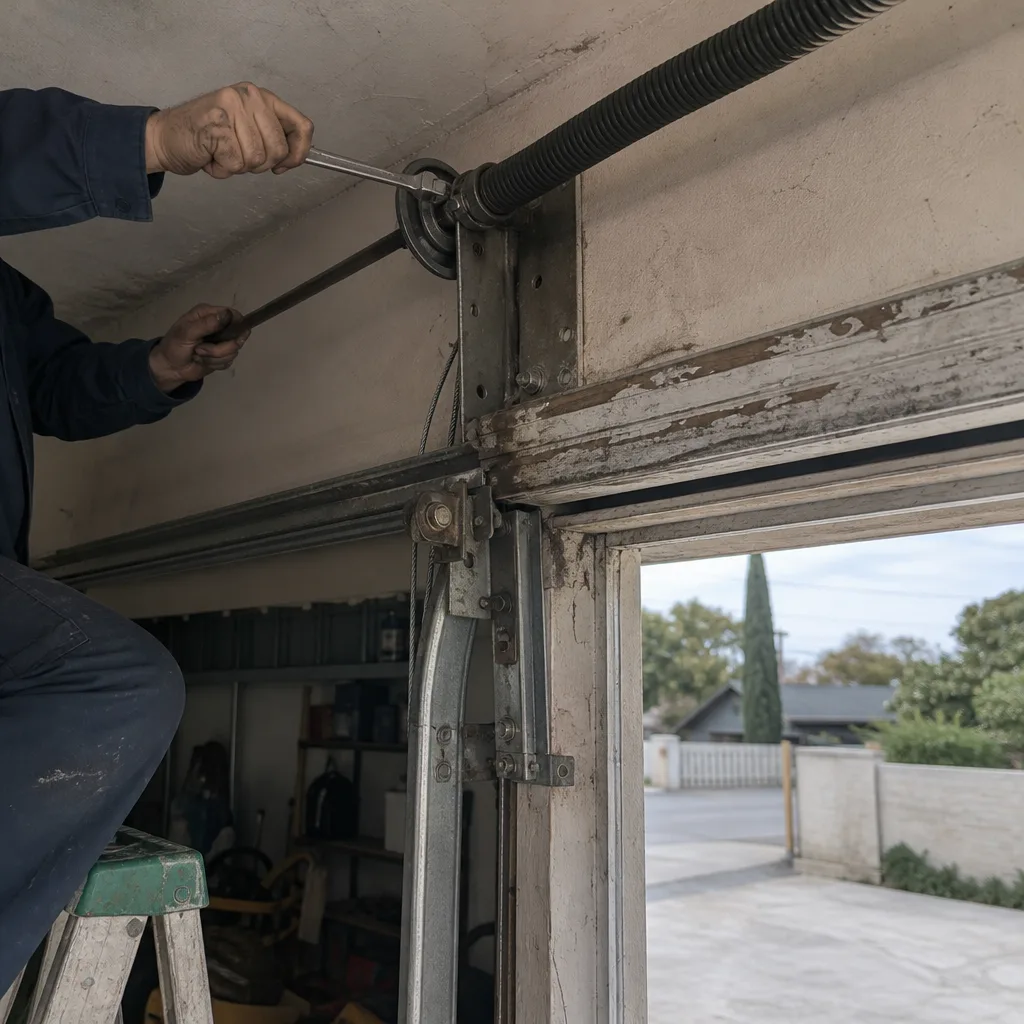
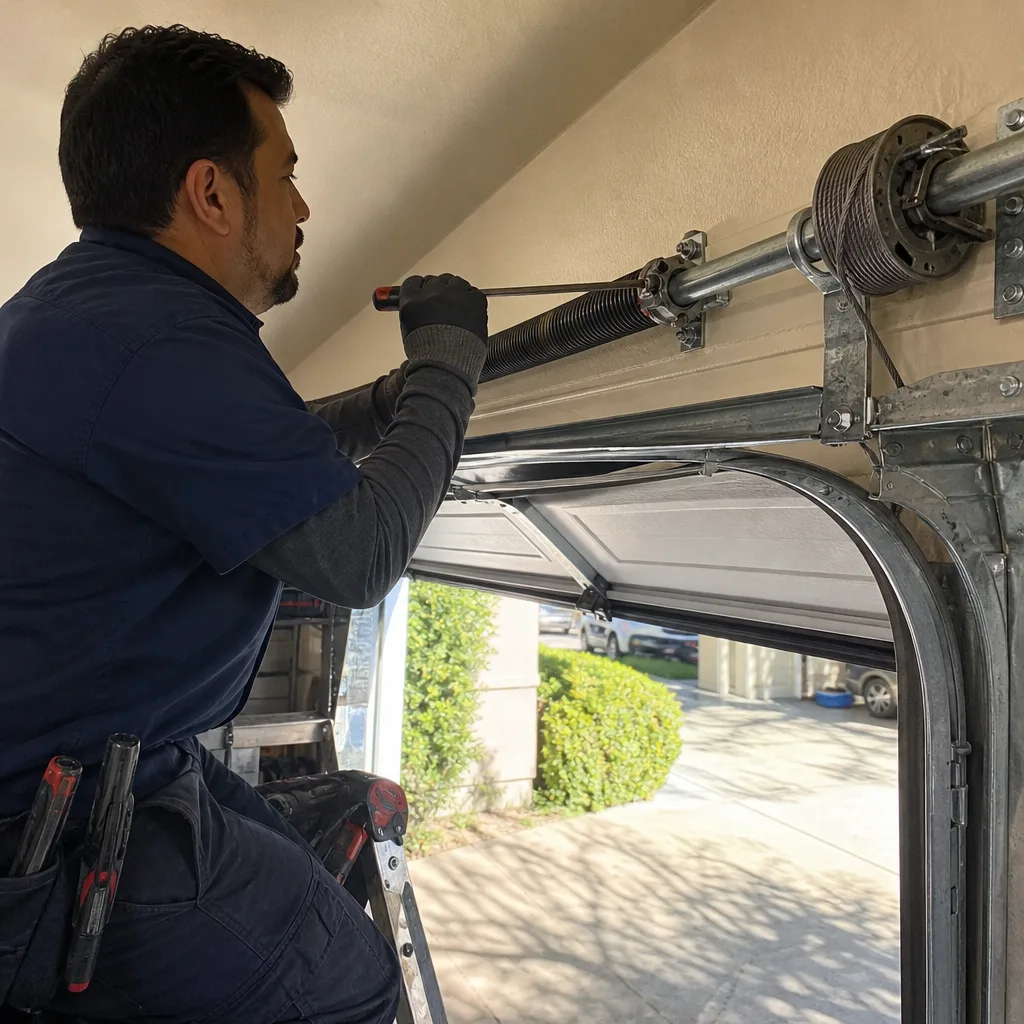
The fix for unlevel track is straightforward for a trained technician: loosen the lag bolts, level the track with a 4-foot level, and resecure. The fix for unequal spring tension is more delicate. Springs under tension store enough energy to cause serious injury if mishandled, and adjusting them is not a DIY job. This is one of the cases where calling a professional isn’t just convenient, it’s the only safe option. A technician will measure the gap, determine which side is under-wound, and add or remove tension in controlled increments until the door sits level.
In Los Angeles, many homes in hillside neighborhoods like Eagle Rock or Mount Washington have garage floors with intentional slope, so installers need to account for that, not just assume the door is wrong. A competent installer checks floor level before setting the tracks and notes any pre-existing slope on the work order. If your installer never mentioned the floor, that’s a red flag.
Grinding Noise When the Door Moves: Rollers and Track Gap
A grinding or scraping sound from a brand-new door is not a break-in issue. It’s a mechanical clearance problem. The door’s rollers, the small wheels attached to the door sections, ride inside metal tracks on both sides. When everything is installed correctly, each roller has about 1/4 inch of side-to-side clearance inside the track. That clearance lets the roller spin freely without binding against the track walls.
When an installer sets the tracks too close to the door, the rollers bind. Too far away, and the rollers can tilt and catch, producing a scraping noise you’ll hear on every cycle. The sound is most obvious when the door passes through the curved section of track near the header, because that’s where alignment stress concentrates.
Common causes of grinding on a new installation:
- Track gap set wrong. The installer didn’t use a spacing tool or measured by eye. Even an eighth of an inch of error produces noise and accelerated roller wear.
- Rollers not seated properly. New rollers sometimes get installed with the stem at a slight angle inside the hinge. The wheel then rubs against one side of the track continuously, regardless of track spacing.
- Track hardware over-tightened. Lag bolts driven too hard can flex the track inward at the bracket points, creating pinch points that scrape the roller edges.
- Debris from installation. Metal shavings, drywall dust, or stray screws left in the track from the installation process grind against the rollers immediately. This one sounds worse than it is and clears with a track wipe-down, but a good installer cleans the tracks before they roll the door the first time.
If the noise is intermittent, you might also be hearing the torsion spring coils rubbing against each other as the door moves. New springs sometimes need a thin coat of spray lubricant where the coils touch. That’s a five-minute maintenance item, not a defect.
For doors with persistent grinding, have a technician inspect track spacing and roller alignment. At Doyle Garage Door Repair home, our technicians check the 1/4-inch clearance at every bracket point before they consider a new door installation complete. It’s the kind of detail that separates a quiet, smooth door from one that sounds like a garbage disposal every morning.
Opener Strains But Door Moves Slowly: Spring Tension Problems
If your new door opens but sounds like it’s working hard, moving slower than it should, or the opener motor gets noticeably warm after a single cycle, the springs are likely under-wound. Following a Garage Door Opener Repair Maintenance Schedule: What to Do and When can help catch this early. A properly tensioned torsion spring should counterbalance enough of the door’s weight that the opener only handles a fraction of the lifting. When the spring is wound one or two turns short of optimal, the opener takes on extra load. The motor strains, the door moves slowly, and wear accelerates on gears, sprockets, and the opener’s internal drive mechanism.
The math matters here. A standard 16-by-7-foot steel door weighs between 150 and 180 pounds. A correctly wound spring system offsets most of that weight so the opener, even a basic chain-drive model rated for 1/2 horsepower, moves the door easily. Under-wind the spring and the opener is suddenly lifting 40 or 50 pounds more than it was designed to handle on every cycle. It works, until it doesn’t.
Signs your new door’s springs are set too light:
- The door moves at different speeds. It rises slowly, then accelerates through the middle, then slows again. That uneven motion means the spring is providing less lift than the door needs.
- The opener housing is warm. After running the door twice, place your hand on the opener motor. If it’s noticeably warm, the opener is working above its intended load.
- The door drifts down when you release it manually. Pull the emergency release. A properly balanced door stays in place when opened halfway. If it slides down, the springs need more tension.
- You hear the opener’s internal gears straining. A grinding or buzzing sound from inside the motor unit, different from the track grinding described above, often means the drive gear is laboring under excess load.
Spring tension is set at the very end of an installation, after the door is hung and balanced. It’s also the step installers sometimes rush because the job looks done from the outside. A reputable installer should test the balance after setting the springs: open the door halfway, release it manually, and confirm it holds position. If your installer never did that test in front of you, ask for it. For Los Angeles homes where garage doors see two to four cycles a day, a badly balanced door will shorten opener life by years, not months.
How to Document an Installation Problem Correctly
The most common mistake homeowners make when a new door misbehaves is letting the installer start adjusting things before the problem is documented. Once parts are moved, settings changed, or springs re-wound, the original configuration is gone. If the dispute escalates, you have no record of what the door was doing before the work began.
Here’s a step-by-step process we recommend to every Los Angeles homeowner dealing with a post-installation issue:
- Video the symptom. Use your phone. Show the door in motion, capture the exact symptom (reversing, gap, grinding, slow movement), and keep the clip under 60 seconds. Start with the door closed or open, film the full cycle, and get close enough to pick up audio.
- Note the date and time. Write down when the symptom first appeared, how often it happens, and whether it’s consistent or intermittent. Include the installation date and the name of the installer or company.
- Do not adjust anything yourself. Even well-intentioned fixes change the evidence. If you’ve already adjusted something, say so honestly when you call. It changes the technician’s diagnosis and it’s better to be upfront.
- Request written acknowledgment from the installer. Before anyone starts work on the fix, ask them to acknowledge the symptom in writing, even in a text message: “Reverses before full close, reported March 14.” That one sentence protects you if the repair doesn’t stick.
- Get the repair in writing too. After the fix, ask what was adjusted, why it was wrong, and what the installer will do if the problem returns. A verbal “should be fine now” is not a guarantee.
This documentation process matters because garage door installation problems often have a delayed onset. A limit switch that’s marginally miscalibrated might not show obvious symptoms for a week. A spring under-wound by one turn may work fine for the first ten cycles, then start struggling as the door settles. If you’ve documented the issue from the first time you noticed it, you’re in a much stronger position at week six or month four.
Spring Tension: What Installers Set at the End and Why It Matters
Torsion spring winding is the last step in a garage door installation because it can’t be done until the full weight of the door is hanging on the track. The installer counts the turns as they wind the spring, and that count determines how much lifting force the spring provides. For a standard residential door, a torsion spring is typically wound between 7 and 8 full turns, depending on the door’s weight, height, and the spring’s wire gauge and inside diameter.
“One too many turns” or “one too few” isn’t a rounding error. Each full turn of a torsion spring adds a meaningful amount of lifting force. One turn too few means the door feels heavy at the bottom of its travel and the opener works harder than it should. One turn too many means the door wants to rise on its own, which creates a different problem: the door may slam open when released manually, and the cable tension may be uneven from side to side.
Here’s what overly tight springs look like in practice:
- The door rockets upward. When you release the door manually at the halfway point, it springs upward. That’s excess tension.
- The door won’t stay closed. With too much spring lift, the door may creep up an inch or two after the opener closes it, then the safety sensor trips and the door reverses.
- The cables go slack. Check the lift cables on both sides when the door is fully open. If they sag, the springs are carrying more than their share of the load.
The tolerance on spring winding is narrow. Installers who count carefully and verify by balance-testing the door at mid-travel get it right almost every time. Installers who rush this step are the reason a new door can develop problems in the first week that the manufacturer never built into it. If your door was installed in Los Angeles recently and you’re dealing with balance issues, Garage Door Installation in Grandview covers spring re-tensioning as part of a correction call, with the before-and-after balance shown to you before the tech leaves.
The Track Gap Specification: 1/4 Inch and What It Means
There’s a number every good installer knows and many never mention to the customer: 1/4 inch. That’s the specified side-to-side clearance between the roller wheel and the inside wall of the track. The clearance lets the roller spin freely, accommodates minor thermal expansion from Los Angeles summer heat, and prevents the binding that produces grinding noise and premature roller wear.
Deviations in either direction create problems:
- Less than 1/4 inch gap. The roller rubs against the track wall. You’ll hear grinding, especially on the curved sections of track. The roller wheel wears down over time, and the door starts to shimmy as it moves.
- More than 1/4 inch gap. The roller has room to tilt. The wheel may ride on its edge instead of its face, producing a scraping sound and uneven wear. In severe cases, a badly tilted roller can jump the track during rapid open or close cycles.
The gap matters most where the vertical track meets the horizontal track near the header. That curved section puts lateral force on the rollers, and it’s where clearance errors produce the loudest noise. It’s also the section installers sometimes narrow slightly to compensate for a bowed wall or an out-of-square opening. A small local adjustment there can fix a rattling door, but a gap that’s too tight across the entire track run is a workmanship issue that should be corrected without charge.
Any Los Angeles homeowner can do a rough check by reaching into the track at several points and feeling whether the roller has room to move side to side. It shouldn’t be wedged tight, and it shouldn’t flop around loosely. Most professional installers at Doyle Garage Door Repair carry a spacing gauge so the check is consistent at every bracket point, not just in the middle of the track.
365-Day Written Guarantee: Installation vs. Repair Coverage
The distinction between an installation warranty and a repair warranty matters most when a problem appears at month four. Most new garage door installations include a parts warranty from the manufacturer, often covering the door panels, springs, and hardware for a set term. But workmanship, meaning whether the door was installed correctly in the first place, is covered by the installer. Some installers offer 30 days. A few offer 90. At Doyle Garage Door Repair, every installation includes a 365-day written guarantee: if it fails because of how it was installed, we come back and make it right at no charge.
Here’s what that distinction means in practice for Los Angeles homeowners:
- Manufacturer defect vs. installation error. If a spring breaks at month two, the manufacturer may cover the spring itself under their parts warranty. But if the spring broke because it was under-wound and the opener was hammering it, that’s an installation error and it’s on the installer to correct.
- Written vs. verbal. A guarantee that’s not written down doesn’t exist in a dispute. We put every guarantee in writing, with the 365-day term stated exactly: “365 days from the date of repair – if it fails, we come back and make it right at no charge.”
- Second visits. If a repair or installation correction fails within the coverage period, a second visit should be free. That includes parts and labor. We specifically cover free second visits, and the policy is automatic, not something you have to argue for.
- What’s not covered. Any warranty excludes damage from misuse, accidental impact, or someone else’s repair work. If you have another company service the door during the coverage period and they change something, that usually voids the workmanship warranty.
When you’re evaluating any garage door company in Los Angeles, ask one question before you sign: “What exactly does your written guarantee cover, and for how long?” If the answer is vague or the guarantee is verbal, walk away. A company that hesitates to put a warranty term on paper will hesitate to honor it later.
Common Mistakes to Avoid
- Letting the installer leave before you test the door yourself. Run the door through three full cycles while the installer is still on site. Watch for the symptoms described above. Most reputable installers expect this and want you to test it.
- Ignoring a reversing door as “sensor sensitivity.” It’s almost never the sensors. It’s the limit switch. Don’t let someone convince you the safety eyes are dirty when the door was just installed.
- Attempting DIY spring adjustment. Torsion springs hold enough stored energy to cause fatal injury. There is no safe DIY spring adjustment. Call a professional.
- Paying for a second opinion without documenting the first problem. Every technician who sees the door second will want to know what the original symptom was. Your video and notes are worth the five minutes they take to record.
- Assuming a manufacturer warranty covers installation errors. It doesn’t. Manufacturer warranties cover defects in materials. Installation errors are the installer’s responsibility, and that’s why the installer’s own written guarantee matters.
- Accepting significant track noise as “normal break-in.” A new door should run quietly from day one. Grinding, scraping, or rattling that lasts beyond the first few cycles indicates a clearance or alignment problem.
- Skipping the balance test at handoff. Ask your installer to demonstrate that the door balances at mid-travel. If they can’t or won’t, that’s a sign the job isn’t complete.
When to Call a Professional
Call a professional when the symptom involves springs under tension, when the door is off its track, when a cable has come loose, or when the opener is straining and you can’t identify the cause from a visual inspection. These are not situations where a second opinion is optional. A door that has come off its track can fall, and a cable under tension can cut or catch. The safest move is to stop using the door and call someone who carries proper tools and parts. If you’re in Los Angeles, Doyle Garage Door Repair offers free estimates and we answer calls live around the clock. All work includes a written price before anything starts and a written 365-day guarantee. Call (910) 858-8029.
Frequently Asked Questions
Your limit switch wasn’t calibrated correctly after installation, meaning the opener thinks the door has hit an obstruction when it actually reached the floor. The fix takes a few minutes and should be free as part of the original installation. Call the installer and ask them to recalibrate the down limit.
If the problem is caused by installation error, the correction should be covered under a workmanship guarantee, so the cost is zero. If you’re dealing with a new company for the fix, expect to pay $85 to $180 for a limit switch adjustment, $140 to $260 for spring re-tensioning, and $200 to $500 for track realignment, depending on the door type and the extent of the work. A written quote before any work begins is standard practice. Call (910) 858-8029 for an exact estimate.
No. Torsion springs hold enough stored energy to cause severe injury or death if they release unexpectedly. Even garage door professionals treat spring work with serious respect and use purpose-built winding bars. This is not a home-improvement project.
A properly installed steel door in Los Angeles should last 15 to 30 years with regular maintenance. Springs typically need replacement after 10,000 cycles, which for most homes translates to 7 to 12 years. Installation errors shorten both figures significantly, which is why a solid workmanship guarantee matters from day one.
It covers workmanship, meaning errors the installer made, not manufacturer defects or accidental damage. If the door was installed incorrectly and the problem shows up within 365 days, the installer returns and corrects it at no charge. Our guarantee states exactly that, in writing, on every job.
For most standard residential replacements where the opening size doesn’t change, no permit is required in the City of Los Angeles. If the installation involves new framing, header work, or structural changes to the opening, a building permit may be needed. Your installer should be able to tell you which situation applies to your home.
The Bottom Line
New garage door problems are almost never the door’s fault. They trace back to what the installer did or didn’t do on day one: a limit switch left uncalibrated, a track set out of level, springs wound with the wrong tension, or rollers set at the wrong track gap. The good news is that all four are identifiable, documentable, and fixable, and a proper written guarantee should cover the correction without cost to you. Document the symptom before anyone touches the door, ask for the installer’s warranty in writing, and don’t hesitate to get a second opinion if the original installer won’t stand behind the work. You’ll find more guides & resources on our blog to help protect your investment. A garage door is the largest moving object in your home, and it deserves the same scrutiny as any other major system.
Written by Aaron Teague, Owner at Doyle Garage Door Repair, serving Los Angeles since 2001.