
Last updated October 9, 2026
Full 25-point door and opener safety check with every visit - springs, cables, rollers, tracks, and your LiftMaster or Chamberlain opener included
You get a price before we start. It does not change when the truck arrives.
 Before
 After
After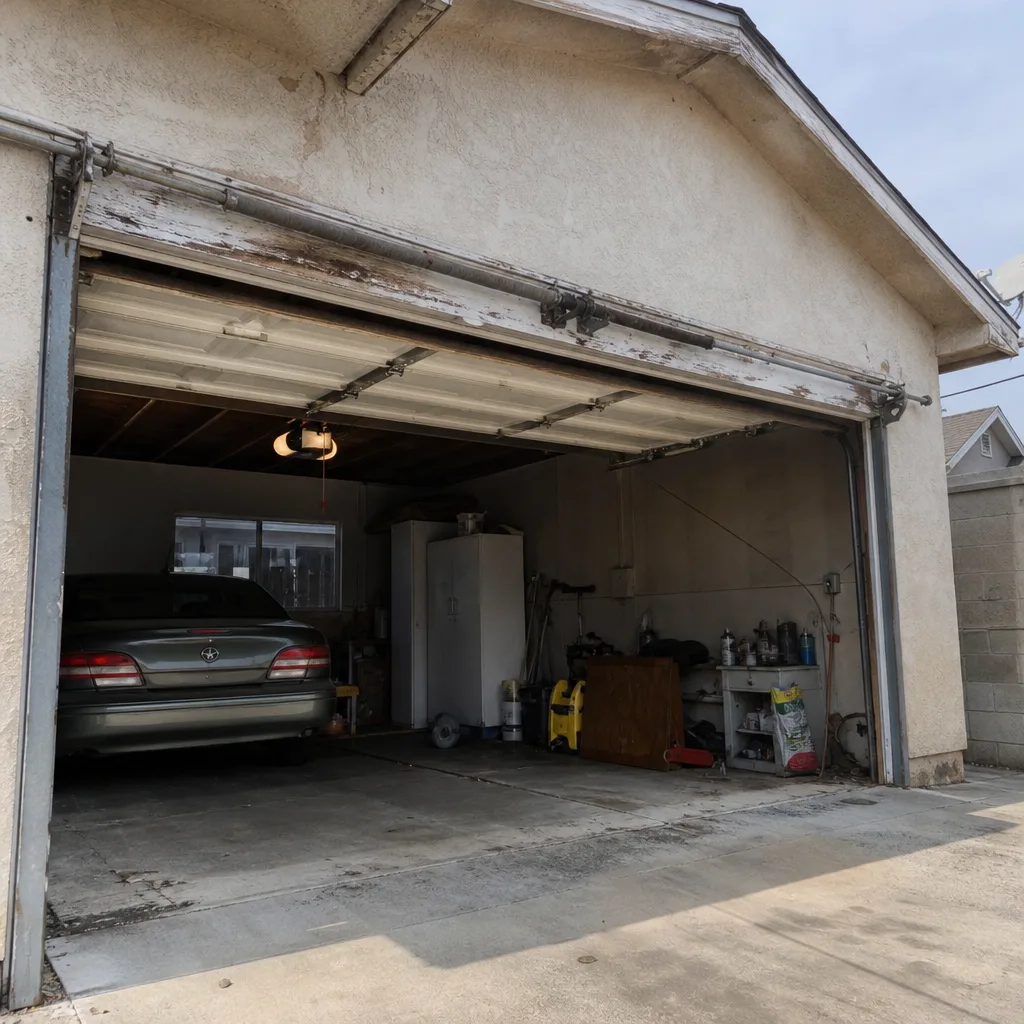 Before
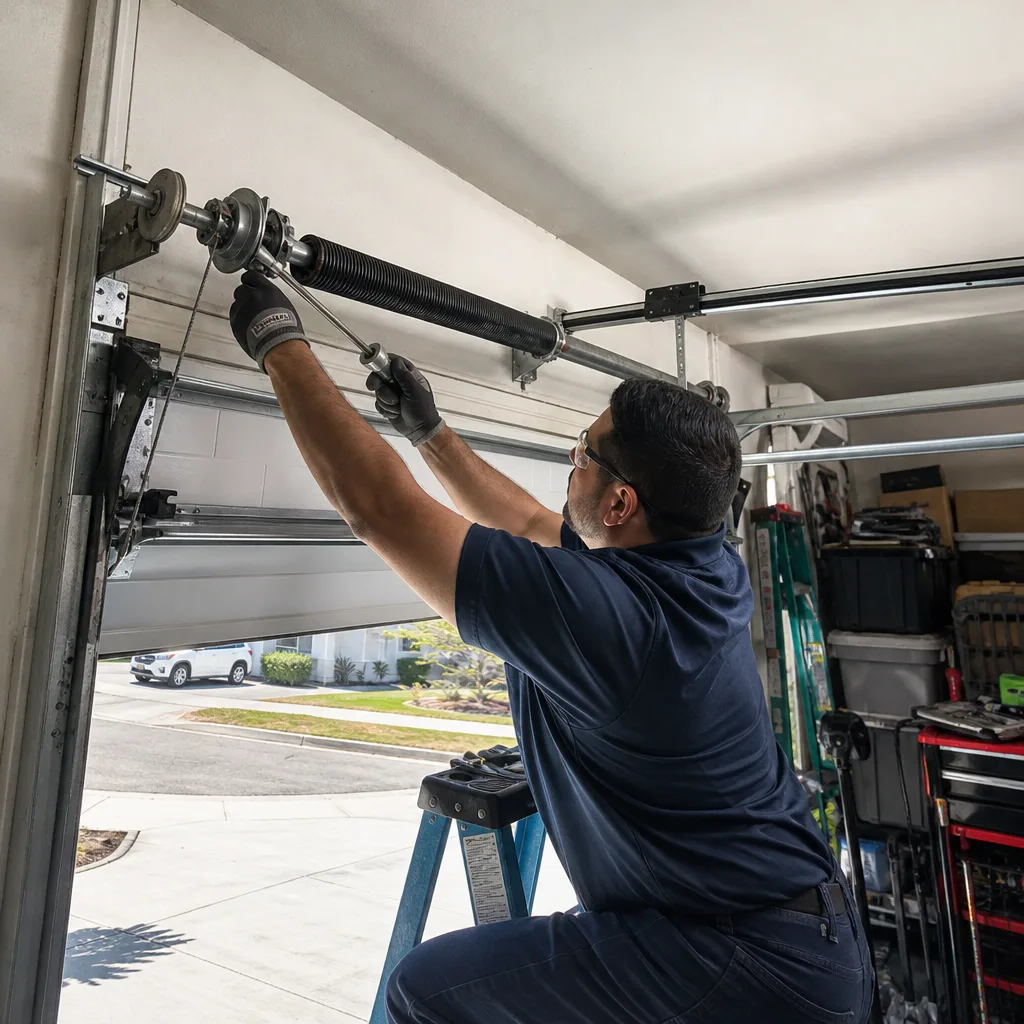 After
After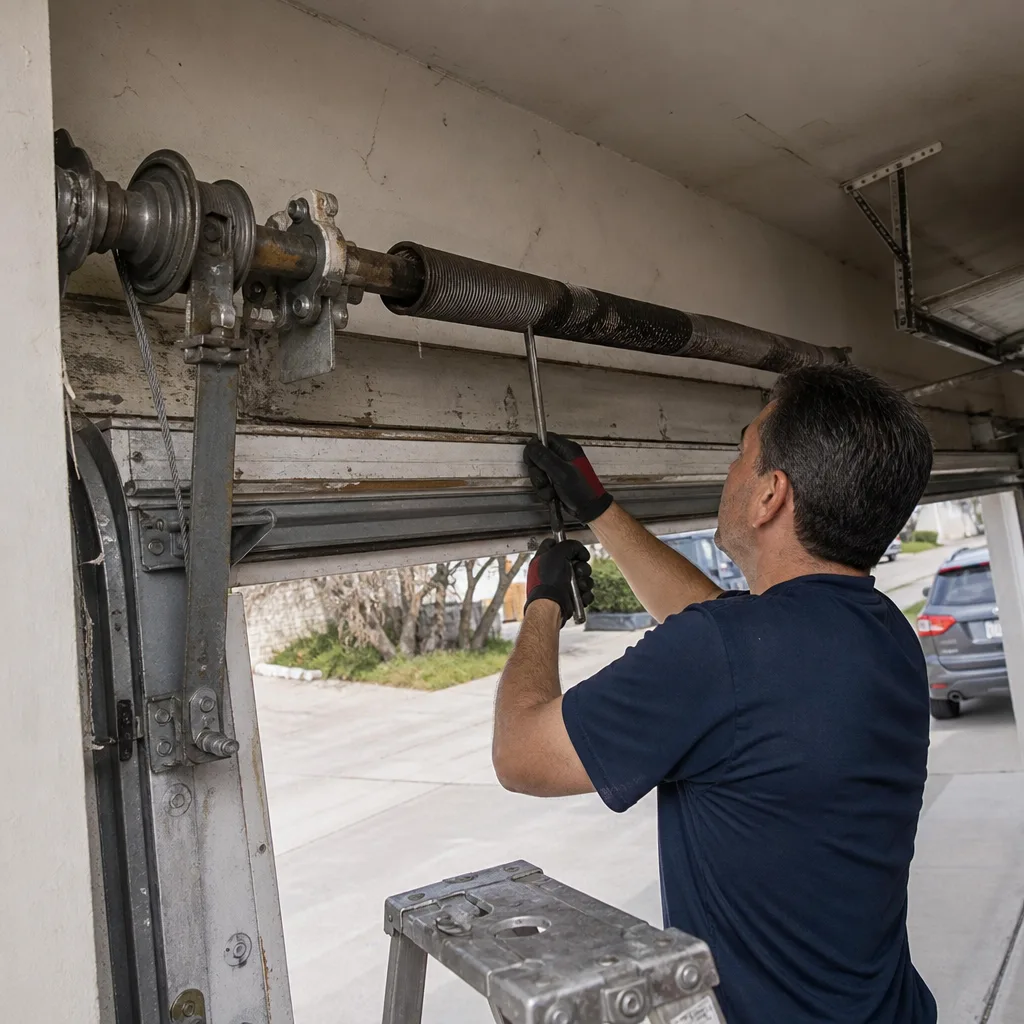 Before
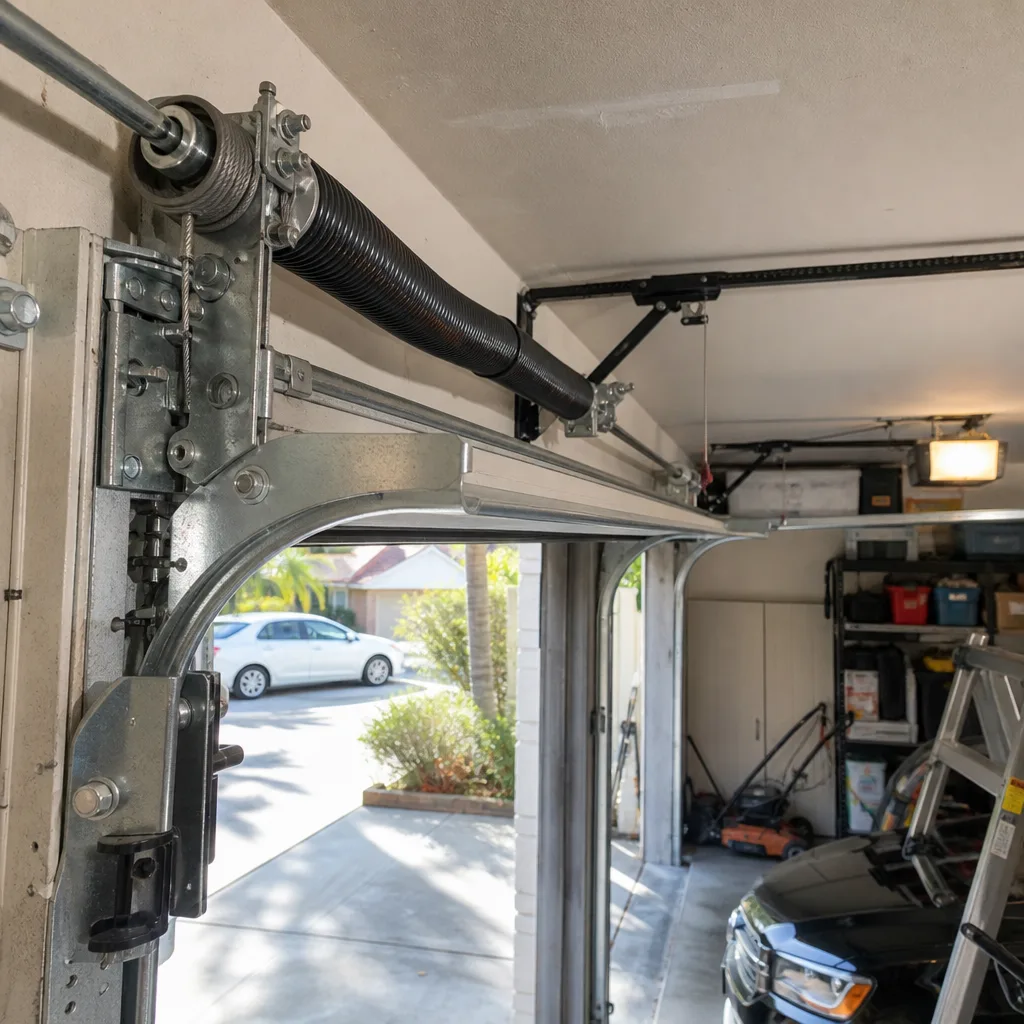 After
AfterGarage Door Repair Warning Signs Every Homeowner Should Know
The warning sign most homeowners miss completely is a door that takes two seconds longer to open than it used to. That hesitation is not an opener getting old. It is a torsion spring losing tension, and catching it at that stage costs a fraction of what it costs after the spring snaps at 6 a.m. on a workday. In Los Angeles, where most garages face direct sun for hours each day, these early signals show up differently than they do in cooler climates. This guide walks through six subtle warning signs you walk past every day, what they mean, and what to do about them before a $150 maintenance fix becomes a $600 emergency call. For a deeper look at what to watch for, see our Garage Door Warning Signs: A Los Angeles Homeowner’s Reference Guide.
Quick Answer
The earliest garage door warning signs are easy to miss: a new hesitation when opening, a gap at the floor on one side when closed, louder-than-usual operation, visible cable slack, an opener that runs longer before the door moves, and weatherstripping pulling away from the frame. Any one of these signals means a component is already wearing, and catching it now costs $150 to $400 in Los Angeles. Ignoring it for another month or two is what turns a simple adjustment into a spring replacement, a snapped cable, or a door off its tracks.
Table of Contents
- 1. New Hesitation on Opening: The Torsion Spring Talking to You
- 2. Asymmetrical Gap at the Floor When Closed
- 3. Louder-Than-Usual Operation: New Noise vs. Old Noise
- 4. Visible Cable Slack on One Side
- 5. Opener Running Longer Before the Door Moves
- 6. Weatherstripping Pulling Away from the Frame
- 7. Los Angeles-Specific Signs: Heat, Salt Air, and What They Do to Your Door
- 8. The Three-Minute Monthly Walk-Around Inspection
- Common Mistakes to Avoid
- When to Call a Professional
- Frequently Asked Questions
- The Bottom Line
1. New Hesitation on Opening: The Torsion Spring Talking to You
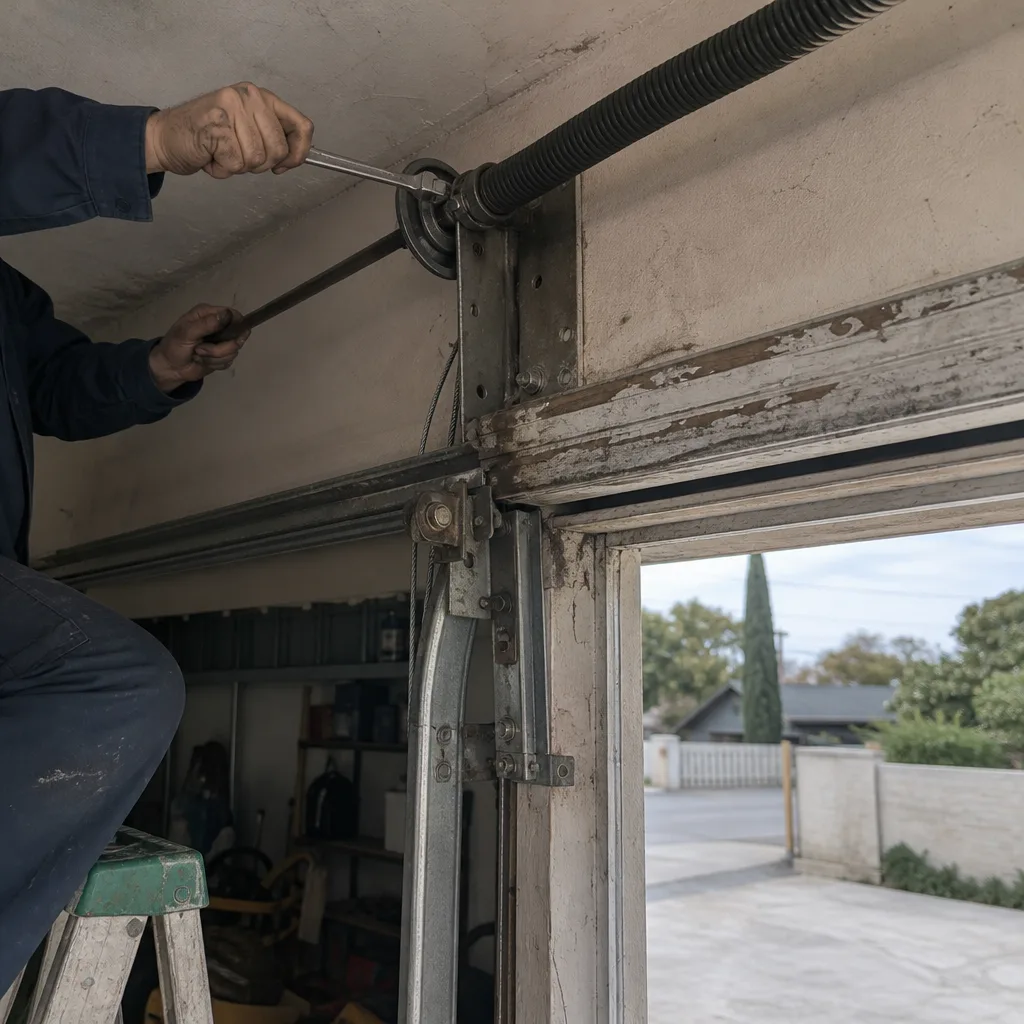
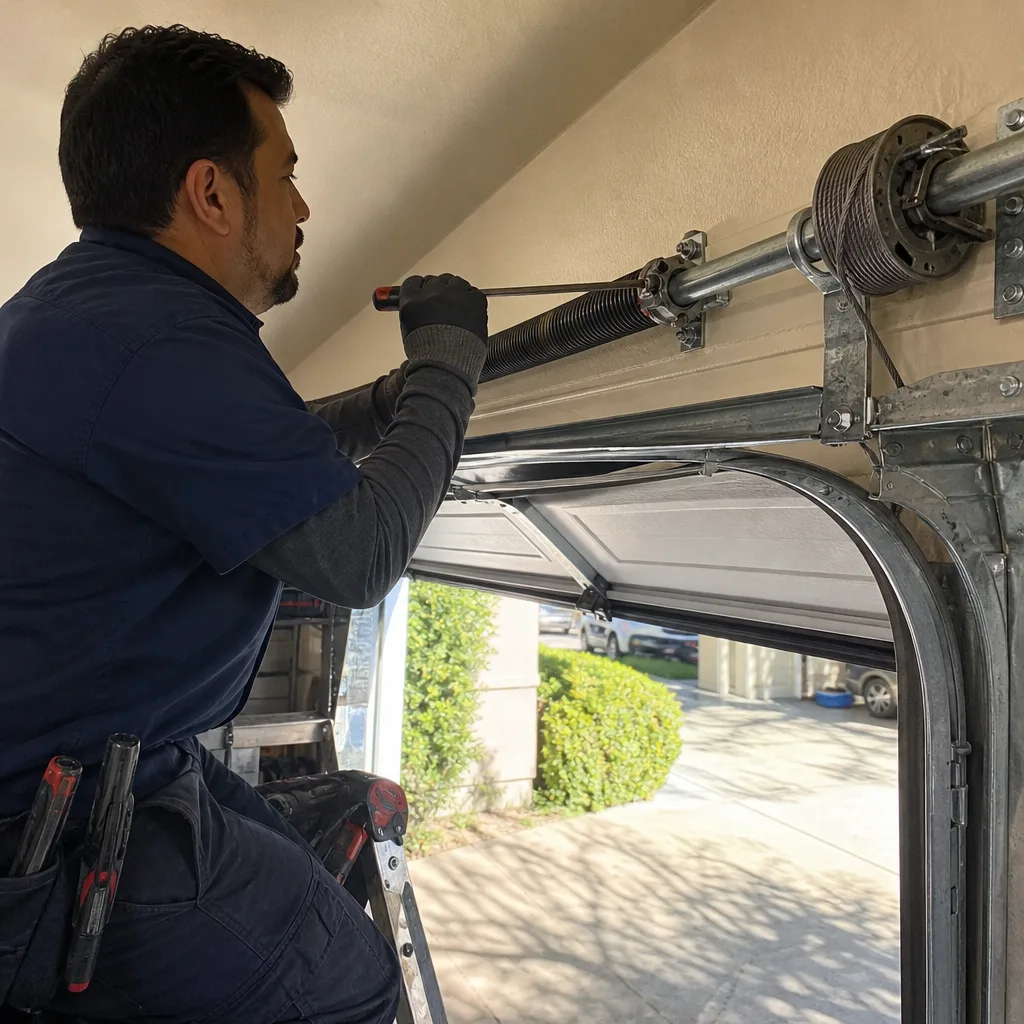
A torsion spring is the large coil mounted horizontally above the door that does most of the lifting. When you press the opener button, the opener motor starts, and the spring winds up to counterbalance the door’s weight. If the spring is losing tension, there is a lag between the motor starting and the door actually moving. You will hear the opener hum for a beat or two before the door begins to rise. That pause is the single most overlooked warning sign in garage door repair.
In our experience across Los Angeles, homeowners rationalize this as “the opener is getting old” or “it’s always done that.” It is rarely the opener. A LiftMaster or Genie opener motor either works or it does not. The hesitation is mechanical: the torsion spring is no longer holding the tension it was set to when it was installed. Springs are rated for a certain number of cycles, typically 10,000 to 20,000 open-and-close operations. A household that opens the door four times a day hits 10,000 cycles in about seven years. If your door hesitates and your spring is older than that, it is telling you it is near the end.
What to listen for: a half-second to two-second delay between the opener engaging and the door moving. What it means: the spring has lost 10 to 20 percent of its tension. What it costs to fix now: a technician can sometimes add tension to an existing spring for $120 to $200 if it has not cracked. What it costs if ignored: a snapped torsion spring replacement in Los Angeles typically runs $280 to $480, and a snapped spring can send the door crashing down if the safety cable is also worn. That is not a risk worth taking.
Safety note: a torsion spring holds enough force to cause serious injury. Never attempt to adjust or replace one yourself. This is a job for a trained professional with the right winding bars and experience.
2. Asymmetrical Gap at the Floor When Closed
Walk out to your closed garage door and kneel down. Look along the bottom edge where the door meets the concrete. If you see daylight on one side and not the other, or if the gap is visibly wider on the left than the right, that is not a settling slab. It is a door that is out of balance.
A balanced garage door rests evenly on the floor across its full width. When one torsion spring is weaker than the other, or when one cable has stretched slightly more than its partner, the door tilts. That tilt puts uneven pressure on the rollers, the hinges, and the tracks. Left uncorrected, the door will grind against the track on one side, the rollers will wear flat spots, and eventually the door can bind or jump the track entirely. A door that comes off its tracks is a safety incident, not just an inconvenience.
The gap to watch for is any difference greater than a quarter inch from one side to the other. It is easiest to spot in the morning or evening when the sun is low and you can see light under the door. If you notice it, call before it gets worse. A cable adjustment or spring rebalancing at this stage often runs $150 to $250 in the Los Angeles market. If the door jumps a track, you are looking at $350 to $600, and that is if the panels are not damaged.
3. Louder-Than-Usual Operation: New Noise vs. Old Noise
Every garage door makes some noise. A door that has been in place for ten years has a baseline sound: the rattle of rollers, the hum of the opener, the creak of the hinges. The question is not “is my door noisy?” The question is “has the noise changed in the last month?”
Here is the distinction that matters for diagnosis. A grinding, metal-on-metal sound that was not there before means a roller bearing has failed or is failing. A popping or creaking sound at a specific point in the travel means a hinge is seizing or a section is binding. A rhythmic thumping as the door moves means the door is out of balance and one cable is working harder than the other. A screech from above the door, near the spring, means the spring itself is dry or starting to fracture.
Record your door on your phone once a month when it is healthy. Thirty seconds of video, no special equipment. That baseline makes it easy to compare. When the noise changes, the change tells us what is failing and roughly where. In our experience with Los Angeles garages, the most common new noise is a grinding from the rollers, because nylon rollers break down faster in sustained heat than they do in temperate climates. Replacing all rollers before one fails completely runs $120 to $220. Replacing a section of track scored by a seized roller runs more.
Quick diagnostic rule: noise that has always been there is maintenance. Noise that is new is a component failing. New noise always has a cause, and the cause does not fix itself.
4. Visible Cable Slack on One Side
The lift cables run vertically along both sides of the door, spooling onto drums above. When the door is up, those cables should be taut on both sides, wrapped evenly on the drums. When the door is down, there should be no visible sag or looseness in either cable.
Stand inside the garage with the door closed and look up at the drums, one on each side of the door. If one cable has a visible loop, a sag, or wraps unevenly on the drum, that is slack. Cable slack means the door is lifting unevenly. The cause is usually a spring that has lost tension on one side, or a drum that has slipped on the shaft. Either way, one side of the door is doing more work than the other.
This is one of the easiest signs to spot and one of the most dangerous to ignore. The cables are under extreme tension when the door is in motion. A cable with slack can jump off the drum mid-cycle, and when it does, the door can drop suddenly on that side. A free-falling garage door can weigh 150 to 400 pounds depending on the model. This is also one of the few issues where we strongly advise against any DIY inspection beyond looking. Do not touch the cables. Do not try to tighten them. A snapped cable can lash out with enough force to cause serious injury.
Catching cable slack early is usually a rebalancing job: re-setting the spring tension and re-spooling the cables. In Los Angeles, that repair typically runs $180 to $300. If the cable snaps, the repair is still manageable at $250 to $400, but the door coming down can damage panels, the track, and anything in its path. The math favors noticing the slack.
5. Opener Running Longer Before the Door Moves
This is related to the hesitation in section one, but it is worth separating because the cause is sometimes different. With this sign, the opener motor runs, the door does not move, and then the door finally engages with a jolt. That jolt is the clue. The hesitation plus a jolt typically means the opener’s internal gear or belt is slipping. The hesitation without a jolt typically means the spring is the issue.
Openers made by Chamberlain, LiftMaster, and Genie use either a chain, a belt, or a screw drive to move the trolley carriage, the part that connects the door to the opener rail. That trolley carriage has a release mechanism, and over time, the internal gears can wear, especially in Los Angeles garages where sustained heat accelerates plastic and nylon gear wear. When the gear slips, the motor spins for a moment before the carriage catches and the door begins to move.
This is a specific failure with a specific timeline. A slipping gear gets worse every week. It does not fail gradually over a year; it fails in a month or two. If you catch it early, replacing a gear kit runs $150 to $250 on most Chamberlain and LiftMaster models. If it fails entirely, the opener will run but not lift, usually at the worst possible time, and a new opener installation runs $450 to $800 in Los Angeles depending on the model and drive type. Wondering how long garage door installation takes? Most standard replacements are completed in a single visit.
6. Weatherstripping Pulling Away from the Frame
The rubber weatherstripping around the sides and bottom of the garage door has a job beyond keeping out drafts. It is the first line of defense against water, dust, pests, and the fine desert dust that blows through Los Angeles garages near the foothills. When the weatherstripping starts pulling away from the frame, it is not just a cosmetic issue. It is a sign that the door is shifting.
The stripping is attached to the door frame or the door edge, and it is designed to compress evenly when the door closes. If the door is out of balance, even slightly, it presses harder against one side, and that pressure works the stripping loose over time. So while the stripping itself is cheap to replace, the reason it is pulling away is what matters. Replacing the strip without addressing the balance issue is like putting a new tire on a wheel that is out of alignment. The new one will wear the same way.
Look at the stripping along the sides of the door, especially at the top corners. If it is peeling, gapped, or if you can see light around the edge of the closed door, the door has shifted. In Los Angeles, where garages are used for storage, workspaces, and sometimes home gyms, sealing the door properly also matters for keeping out the fines from the Santa Ana winds. Replacing weatherstripping runs $80 to $180. Rebalancing the door at the same time is the part that makes the fix last.
7. Los Angeles-Specific Signs: Heat, Salt Air, and What They Do to Your Door
Garage doors in Los Angeles face conditions that doors in most of the country never see. Daytime temperatures over 90 degrees for months at a stretch. Intense UV exposure. Salt air near the coast from San Pedro up through Malibu and into the South Bay. Each one leaves a signature on the door hardware, and learning to read those signatures can save you hundreds.
Heat is the biggest factor. Metal expands in heat, but different metals expand at different rates. The spring anchor bracket, the steel plate that holds the torsion spring to the header, and the galvanized spring itself expand and contract at different rates. Over years of heat cycling, that repeated movement creates microscopic gaps that let in moisture. The result is rust streaking. If you see rust stains running down from the spring anchor bracket or the end bearing plates, that rust is telling you that the spring and its mount have been heat-cycled to the point of fatigue. It is not a guarantee the spring is about to fail, but it is a strong indicator that the spring is in the second half of its life.
Near the coast, salt air accelerates corrosion on the cable drums, the pulleys, and the fasteners. Look for white oxidation, a powdery white residue on any aluminum or galvanized hardware. That white oxidation on cable drum hardware means the drums are pitting, and pitted drums chew through cables. A drum that looks crusty at the edges will eventually fray the cable it is supposed to guide. Replacing drums and cables together costs $250 to $400. Replacing them before the cable snaps is always cheaper and safer.
Inland, in neighborhoods like the San Fernando Valley, Pasadena, and Burbank, the enemy is dust and extreme temperature swings between day and night. Dust works into the roller bearings and the hinges, turning smooth movement into grinding. The temperature swings mean the springs cycle through more expansion and contraction cycles than they would in a stable climate. A spring might last 10,000 cycles in a mild climate but wear faster where daily temperature swings exceed 30 degrees.
8. The Three-Minute Monthly Walk-Around Inspection
The best garage door maintenance tool in your house is your phone camera and three minutes of your time. For more guides & resources on keeping your door running smoothly, visit our blog. This inspection catches roughly 80 percent of developing problems before they become breakdowns. Do it on the first weekend of every month. Here is the walk-around, in order:
- Stand inside with the door closed. Look up at the springs. Any rust streaking, white oxidation, or visible gaps in the coils? If yes, take a photo.
- Look at the cables. Both taut? Both wrapped evenly on the drums? Any slack, fraying, or loose strands? Take a photo of anything that looks different from last month.
- Open the door and watch it travel. Does it hesitate before moving? Does it jerk partway up? Does it move smoothly on both sides? Listen for any new noise.
- Close the door and check the floor gap. Even gap on both sides? Or daylight on one side only? Take a photo of the bottom edge.
- Walk outside and check the weatherstripping. Pulling away anywhere? Compressing evenly? Any gaps where light comes through?
- Note the dates. On your phone or a small chalkboard in the garage, write the date of the inspection and anything unusual. Three data points over three months tells us a lot.
What to document before you call: photos of anything unusual, the dates you first noticed each issue, and the make and model of your opener if the issue involves the opener. A clear photo and a date helps us give you a more accurate estimate over the phone. Instead of a blank “depends what we find,” we can usually give you a price range before the visit, because we know exactly what we are looking at and how long the fix typically takes in Los Angeles.
Common Mistakes to Avoid
- Ignoring the hesitation because “it still works.” A door that hesitates is not working. It is failing slowly. Every week you wait, the spring loses more tension, and the repair moves from adjustment territory into replacement territory.
- Lubricating a new noise to make it go away. Lubricant silences a noise without fixing the cause. A screeching spring or grinding roller that has been greased is still a failing component, now with a quieter death rattle.
- Testing a suspected cable or spring problem by hand. Never grab a cable or spring to see if it is loose. These components hold enough tension to cause life-changing injury. Look with your eyes, not your hands.
- Assuming the door is the problem when the opener is. Or the reverse. A door that will not move can be an opener gear failure, a spring failure, or a cable failure. Guessing wrong leads to buying a part you do not need.
- Replacing weatherstripping without checking the balance. The stripping is a symptom indicator. Replace the strip, but verify the door is balanced, or the new strip will pull away within months.
- Waiting until the door stops working to look for a repair company. That is how you end up calling the first name you see at 7 a.m. on a Monday before work. Finding a company you trust before you need them means you make a calm, informed decision instead of a rushed one.
When to Call a Professional
Call when you notice any of the signs above. That is not an overreaction. A new hesitation, an uneven gap, cable slack, a new grinding noise, or stripping that is pulling away all mean something is already failing. Call when you are not sure, too. A professional inspection takes less than an hour, and in many cases the inspection itself is all you need to know whether you have months or days before a failure.
If the door will not open or close, if a cable has snapped, if the spring has broken, or if the door has come off its tracks, do not try to force it. Call a professional. Doyle Garage Door Repair offers free estimates in Los Angeles, and a live person answers the phone 24/7 at (910) 858-8029. You will get a written price before any work begins, and every repair is covered by the 365-Day Done Right Promise: if it fails within 365 days of the date of repair, we come back and make it right at no charge.
Frequently Asked Questions
In Los Angeles, torsion spring replacement typically costs $280 to $480 depending on the spring size, the number of springs, and the door weight. A spring adjustment, when the spring is still intact but has lost tension, costs $120 to $200. Doyle Garage Door Repair gives you a written price before any work starts, so there are no surprises. Call (910) 858-8029 for an exact quote, and the estimate is free.
Yes. A hesitating door is usually a spring tension issue or an opener gear problem, and both are repairs we complete the same day in most cases. The sooner you call, the more likely the fix is an adjustment rather than a full replacement. Call (910) 858-8029, and a real person answers 24/7, including weekends and holidays.
No. The price we quote is the price you pay. We write it down and hand it to you before a single bolt is turned. If we find something unexpected during the repair, we stop and discuss it with you before doing anything else. No verbal estimates, no invoice surprises.
We carry the most common replacement parts on every service vehicle: torsion springs, extension springs, cables, rollers, hinges, weatherstripping, and opener gear kits for LiftMaster, Chamberlain, Genie, and Raynor openers. In most cases, the part is on the truck when we arrive, which means the repair is completed in a single visit.
A well-maintained garage door in Los Angeles lasts 15 to 30 years depending on the material, sun exposure, and proximity to the coast. The springs usually last 7 to 12 years with normal use. The opener typically lasts 10 to 15 years. The environment matters: a door facing direct sun in the Valley will wear faster than a shaded door in Santa Monica.
If your door is more than 20 years old, showing signs of panel warping, or if you have already replaced springs twice, it is usually more cost-effective to plan a replacement on your schedule than to wait for a failure. A new door installation in Los Angeles typically runs $1,200 to $3,500 depending on the size, material, and insulation. You can see our Garage Door Installation in Grandview page for more detail on what affects the price.
The Bottom Line
Garage doors do not fail without warning. They fail after weeks or months of signals that are easy to spot once you know what to look for. A hesitation on opening, an uneven gap at the floor, a new grinding noise, cable slack, a slow-engaging opener, and weatherstripping pulling away are all early indicators, and each one is cheaper to fix the day you notice it than the day it cascades into a full failure. Los Angeles heat, coastal salt air, and inland dust accelerate the wear, which makes a monthly three-minute inspection the highest-value maintenance task you can do. When you see something, document it and call. From our Doyle Garage Door Repair home page to every service call we run, the process is the same: a background-checked technician with a name and photo sent before arrival, a written price handed to you before work begins, and a 365-day written guarantee on every repair. We also publish detailed local service pages for Garage Door Repair in Grandview and Garage Door Opener Repair in Grandview if you want to see how those services work in your area.
Call (910) 858-8029 when you notice any of these signs. A real person answers, day or night, and the estimate is free. Aaron Teague and our team at Doyle Garage Door Repair have served Los Angeles since 2001, and we would rather catch the problem at $150 than at $600.
Written by Aaron Teague, Owner at Doyle Garage Door Repair, serving Los Angeles since 2001.