
Garage Door Repair: Repair or Replace? How Los Angeles Homeowners Decide
Here’s the straight answer: repair the door if the failed component is isolated and the total repair history is under 40% of replacement cost. Replace it if you’ve crossed that line, if the door is over 15 years old with multiple worn parts, or if panel damage affects the door’s structural integrity. Most Los Angeles homeowners never get this math from their repair company because a company that only does repairs has every reason to keep repairing, and a company that only does replacements has every reason to sell you a new door. We’ll walk you through the actual decision framework we use with our own customers. If you’d rather just talk it through, call (910) 858-8029 and we’ll give you an honest read in five minutes.
The 40% Rule: How to Calculate Whether Repair Has Already Cost You Too Much
The industry benchmark is simple: when cumulative repair costs on a garage door exceed 40% of the door’s replacement value, replacement almost always costs less over a five-year horizon. Let’s put that in real Los Angeles numbers. A mid-range 16-foot steel garage door with installation runs roughly $1,800 to $2,800 in Los Angeles, depending on insulation, window options, and whether you’re replacing the tracks at the same time. Forty percent of that is $720 to $1,120. If you’ve replaced two torsion springs at $200 to $350 each, paid $150 for a cable repair, and another $200 for a roller replacement, you’re already past $900. You’re at the threshold, and that’s before the next failure.
Here’s the calculation we walk customers through when they call us for Garage Door Repair in Grandview or anywhere in the Los Angeles area:
- Add every bill from the last 24 to 36 months. Springs, cables, rollers, hinges, opener issues, track adjustments. Write it all down.
- Get a real replacement quote. Not a ballpark from a website. A written quote for your specific door size and configuration.
- Divide repair costs by replacement cost. If the number is under 40%, repair is defensible. Over 40%, replacement wins on a five-year cost basis almost every time.
What this framework does is remove the emotional pressure from the decision. You’re not deciding based on whether the technician seems like a nice person or whether the dispatch line sounded friendly. You’re deciding based on numbers you can see on paper.
Which Failures Signal the End of the Door, and Which Are Just Normal Maintenance
Not all breakdowns carry the same weight. In Los Angeles, where we see everything from salt air corrosion in Venice to dry heat cracking in the San Fernando Valley, certain failures tell you a lot more about the door’s remaining life than others.
Components that are normal to replace, regardless of door age:
- Torsion springs (the large coils mounted above the door that do most of the lifting) are rated for 10,000 cycles, which translates to roughly 7 to 10 years for most Los Angeles households. A broken spring on a 6-year-old door is normal wear, not a sign the door is dying.
- Garage door cables fray and snap with age, especially in coastal Los Angeles neighborhoods where moisture accelerates corrosion. Replacing a cable on a door that’s otherwise fine makes sense.
- Rollers wear out. Nylon rollers last 10 to 15 years, steel rollers less. Worn rollers make noise and strain the opener, but they don’t condemn the door.
- Weather stripping and bottom seals degrade in Los Angeles heat. A cracked seal is a $15 to $50 fix, not a reason to replace a door.
Components that signal the door itself is nearing the end:
- Multiple panel cracks or dents. One dented panel on a 3-year-old door might justify a single panel replacement, but we see doors in Los Angeles where sun damage and impact have left three or four panels compromised. At that point, a panel-by-panel approach costs more than a new door and leaves you with a mismatched face.
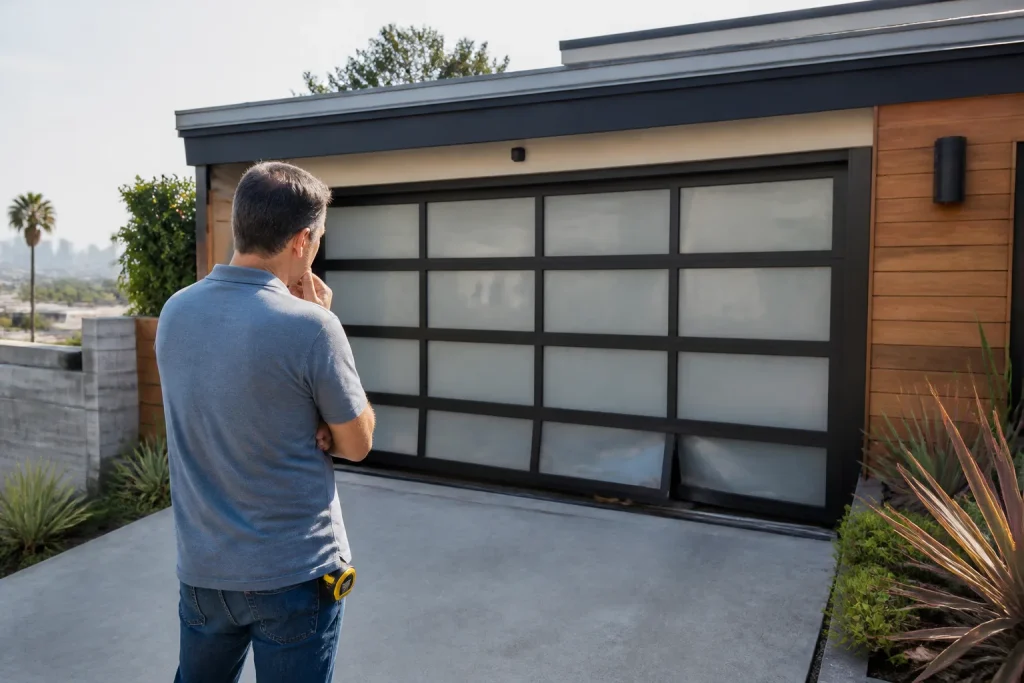
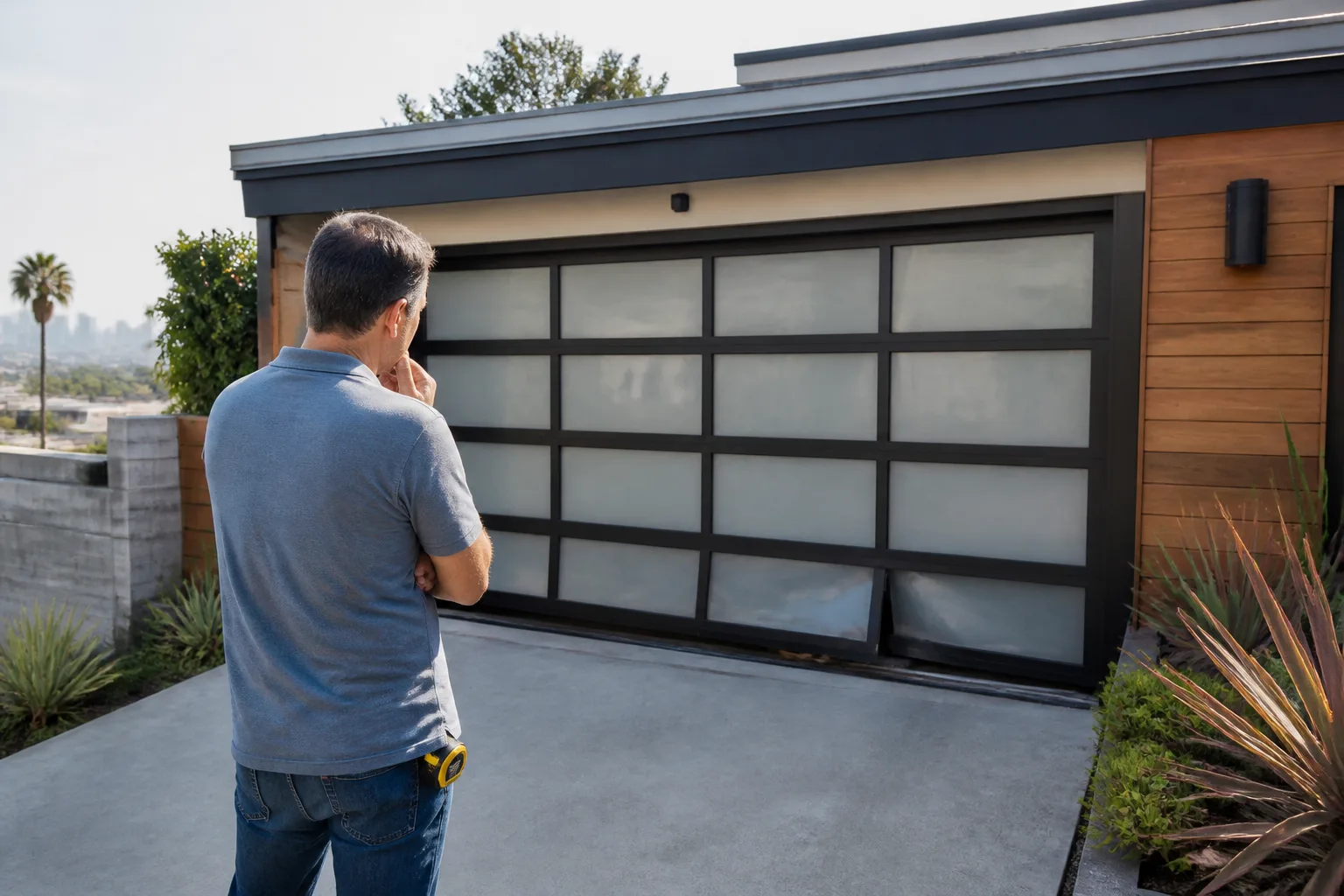
- Section separation. On older steel doors in Los Angeles, the adhesive and fasteners between panels eventually fail. When sections start pulling apart, the door’s structural integrity is gone, and repairs are pushing a boulder uphill.
- Track damage or severe misalignment. Replacing tracks on a 20-year-old door is a real job, and on a door that age, you’re often better off replacing the entire system than trying to marry new tracks to an old door.
- Repeated spring failures within a short window. If you’ve broken two torsion springs in 18 months, something is off with the door’s weight distribution, and the spring isn’t the root problem.
One more point here. A company that only repairs has zero incentive to tell you about the 40% rule. A company that only installs has zero incentive to mention that a $275 spring replacement would solve your problem today. This is exactly why we show both options, in writing, on the same repair ticket. You get the repair quote and the replacement quote side by side, and you make the call with complete information.
Panel Damage, Bottom Seals, and Weather Stripping: The Overlooked Cost Factors
Los Angeles homeowners often ignore the slow deterioration that doesn’t involve a dramatic spring break or a door off its tracks. But panel damage, bottom seal condition, and weather stripping directly affect both your energy costs and the door’s structural future, and they belong in any repair-or-replace calculation.
Panel damage matters more than most people think. A garage door’s panels are load-bearing. When a panel dents, cracks, or delaminates, the stress moves to the panels around it. In Los Angeles, where many garages are attached and adjacent to living space, a warped or separated panel also means rising cooling costs in summer, plus easy entry points for rodents and water. We frequently see doors in Los Angeles neighborhoods like Northridge and Woodland Hills where dry heat has cracked the outer panel skin and moisture has then worked into the foam core. By the time the homeowner notices, two or three panels are involved.
The bottom seal and weather stripping are the cheapest components on the door and the most commonly deferred. A cracked bottom seal lets dust, water, and pests under the door, and in hillside Los Angeles neighborhoods where garages sit below grade, a failed seal can mean standing water after winter rain. Replacing a bottom seal is a simple job, often $80 to $150 in Los Angeles. Replacing insulation that’s been soaked by a failed seal can add $400 to $700 to a repair bill later.
Here’s a useful way to think about it: these smaller issues don’t usually push you into replacement on their own. They do, however, shift the 40% calculation. If you’re already at $600 in spring and cable repairs, and then you add panel work plus sealing, you may have crossed the threshold without realizing it. That’s why we write every quote down and itemize every component. You should never be surprised to find out where you stand.
Why You Should Trust the Company That Quotes Both Options in Writing
Here’s the uncomfortable truth about the garage door trade. Companies that only offer repair will rarely recommend replacement, even when replacement is clearly the cheaper five-year option. Companies that only sell new doors will rarely recommend a $250 spring repair, even when the existing door has ten good years left. The only recommendation you can trust comes from a company that profits either way and shows you both numbers on paper.
We do both Garage Door Installation in Grandview and full repair and replacement work across Los Angeles, and our policy is to put both options in writing whenever a door is near the 40% line. Sometimes the answer is a straightforward repair. Other times, we’ll tell a customer they’ve already spent more than the door is worth, and we’ll show them the math. That conversation is never comfortable, but it’s the one we’d want someone to have with us.
The other piece of this is the guarantee. Most Los Angeles companies offer 30 days, or 90 if you’re lucky. If a repaired component fails within a year, our response isn’t a debate about whether it was “normal wear.” Our 365-day guarantee means we come back and make it right at no charge, every time, in writing. A repair that can’t make it a full year isn’t a repair; it’s a temporary fix, and a guarantee like this exposes that immediately. If the repaired component keeps failing, the obvious next conversation is replacement. You shouldn’t need to wonder whether that conversation will cost you anything. Under the 365-Day Done Right Promise, it won’t.
We pulled a door out of a garage over in Echo Park last year where the homeowner had paid another company for three roller replacements in 14 months. The rollers were fine. The tracks were out of alignment, and the door was eating rollers because of it. The fix was a track realignment, not a fourth roller set. That’s the difference between a company that sells you parts and a company that looks for the actual problem.
When to Call a Professional Versus Continuing to Patch the Door
There’s a point in every aging garage door’s life where the incremental repairs stop making sense, and you don’t need a calculator to see it. If your door is making grinding sounds that persist after repairs, if the panels visibly flex when the door moves, if you’re hearing the opener strain against a door that’s getting heavier year by year, you’re not maintaining a door anymore. You’re nursing it.
Call a pro when you’re at that point, but call before the door fails catastrophically. A garage door that comes off its track or drops because of a snapped spring can cause serious injury or property damage. Torsion springs hold enough tension to be genuinely dangerous, and no homeowner should ever attempt to remove, wind, or adjust one themselves. That job belongs to a trained professional with the right tools, and in Los Angeles, it’s a call you should make before you’ve got a door hanging half-open.
Related services in Los Angeles: when the opener itself is the problem, that’s a different conversation than door replacement. Read our guide on Garage Door Opener Repair in Grandview if your door is struggling to move but the panels and springs are sound. And if you’re replacing your door, you’ll likely want to evaluate your opener at the same time, which is where a company that handles both becomes especially useful.
The Bottom Line
The repair-or-replace decision for a Los Angeles garage door has a mathematical core, not just a financial one. Track your repair spending. Get a written replacement quote. Compare the two. If repair costs exceed 40% of replacement, or if the door is over 15 years old with failing panels, damaged tracks, or repeated spring breakage, replacement wins over a five-year horizon. If the failure is isolated and the repair history is short, fix it and keep the door.
The variable that changes everything is whether you trust the numbers you’re being given. A company that only sells one outcome can’t be trusted to recommend the other. We carry all major brands, including Wayne Dalton, LiftMaster, and Raynor, and we’ll quote repair and replacement side by side, in writing, before any work starts. If you’re in Los Angeles and need help, Doyle Garage Door Repair home offers free estimates. Call (910) 858-8029 and we’ll walk you through the math over the phone.
Frequently Asked Questions
A mid-range 16-foot steel garage door with installation in Los Angeles typically runs $1,800 to $2,800. Insulated doors, custom windows, and high-end brands like Wayne Dalton or Raynor can push that to $3,500 or more. A basic single-car door replacement starts around $1,200. Every quote we give is written down before work starts, so you’ll see the exact number before you make any decision. Call (910) 858-8029 for an exact quote for your door.
Fifteen to twenty years is typical for a steel garage door in Los Angeles, though coastal exposure in neighborhoods like Santa Monica, Venice, and Playa del Rey can shorten that lifespan because salt air accelerates corrosion on hardware and panel fasteners. Torsion springs last 7 to 10 years regardless of door age, so a spring failure on a 12-year-old door doesn’t mean the door is done.
It depends entirely on your repair history. A single broken spring at $200 to $350 is far cheaper than a $2,000 replacement. But if you’ve already spent $900 or more on repairs in the last two to three years, replacement is usually cheaper over the next five years. The 40% rule is the framework: once cumulative repair costs exceed 40% of replacement cost, replacement wins. We’ll show you both numbers in writing so the math is clear. Call (910) 858-8029 for a free estimate.
Yes, if the door is relatively new and the panel is still in production. But on older doors, or when multiple panels are damaged, single-panel replacement leaves you with a patchwork door that won’t match and can cost 30% to 50% of a full replacement anyway. We’ll tell you honestly whether a panel replacement makes sense for your specific door, and we’ll show you the cost difference in writing before you decide. Call (910) 858-8029 to talk it through.
Written by Aaron Teague, Owner at Doyle Garage Door Repair, serving Los Angeles since 2001.
Need Garage Door Help?
Call Doyle Garage Door Repair - licensed & insured, here with fast after-hours help in Los Angeles.
(910) 858-8029