
Emergency Garage Door Repair Near Me: What Los Angeles Homeowners Should Do First
If your garage door just snapped a spring, threw a cable, or jammed halfway up at 9 p.m., the first thing to do is stop touching it. A broken torsion spring, the large coil mounted above the door that does most of the lifting, still holds roughly 400 pounds of tension even after it snaps. Forcing the door now is how a $150 spring replacement turns into a $900 cable-and-drum job. We’re going to walk you through exactly what to check from inside the garage, what not to touch, and how to get a real person on the phone who’ll tell you the price before a truck ever leaves the shop.
If you’d rather not spend the next ten minutes reading, call (910) 858-8029 right now. A live person answers day, night, weekends, and holidays, and we’ll talk you through what you’re looking at before anyone gets in a vehicle.
Identify the Emergency Without Touching Anything
You can diagnose most garage door failures in Los Angeles from six feet away. Stand inside the garage, look up, and check four things in order. First, look at the torsion spring above the door. If you see a visible gap in the coil, it’s broken. That spring is under enough tension to take off a finger or worse if it lets go while you’re near it, so do not stand directly under it and do not try to wind or unwind anything yourself. This is genuinely dangerous, and you want a trained professional with the right winding bars and experience.
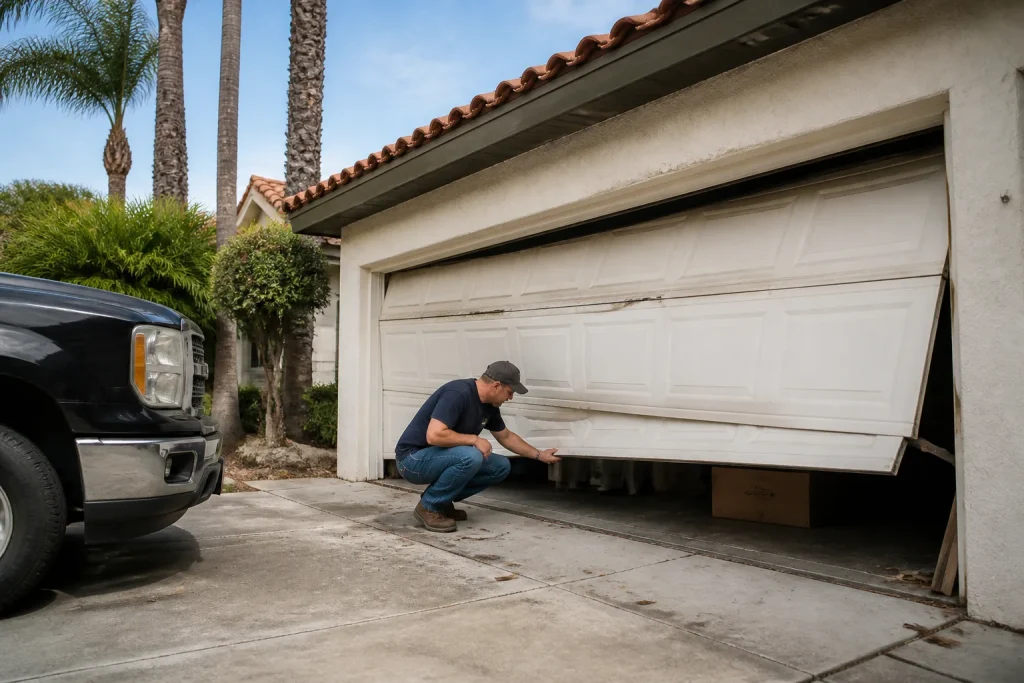
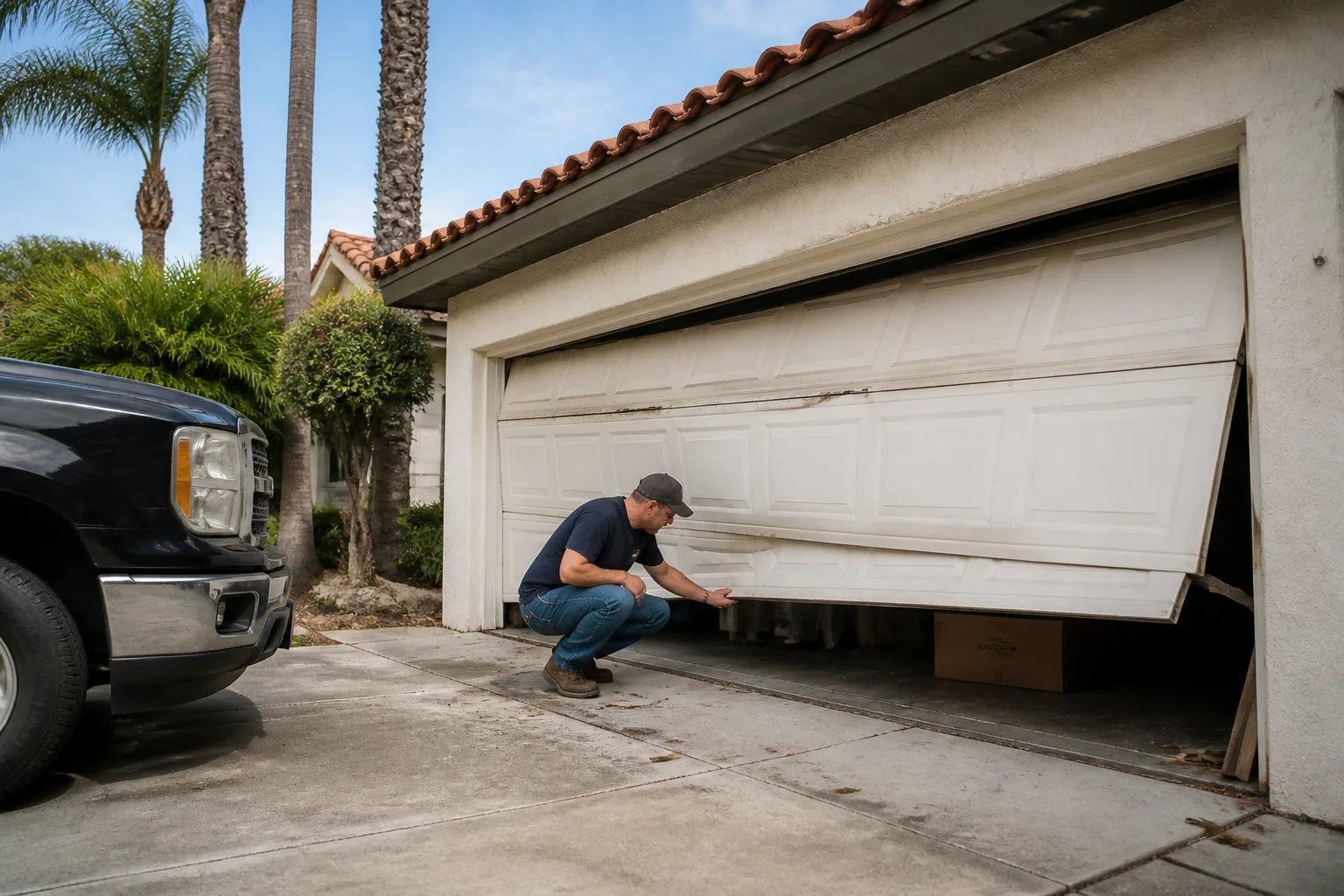
Second, check the cables on either side of the door. If one looks frayed, loose, or completely detached from the drum at the top, that’s a snapped cable. Third, look at the track, the metal rail the rollers ride in. If the door is tilted or a roller has popped out of the track, you have an off-track door. Fourth, if the door hasn’t moved at all but you heard the motor humming, it’s likely the opener, meaning the trolley carriage, the part that pulls the door along the rail, or the limit switch inside the unit has failed. LiftMaster and Chamberlain openers both fail this way more often than homeowners expect.
- Broken torsion spring: visible gap in the coil above the door. Do not touch. Call a pro.
- Snapped cable: frayed or dangling cable on the side. Door may be crooked.
- Off-track door: roller out of the rail, door tilted, grinding sound.
- Opener failure: motor runs but door doesn’t move, or door reverses immediately.
None of these require you to put a hand on the door itself. The instinct to give the door a shove or hit the opener button three more times is exactly what makes the repair worse. A door with a broken spring weighs 150 to 250 pounds depending on the model. When you force it, the cables go slack, the drums unwind, and now you’re replacing everything instead of one spring.
The Manual Release Cord: When It’s Safe and When It Will Drop the Door
Every garage door opener has a red cord hanging from the rail. That cord releases the door from the opener carriage so you can operate it by hand. It’s designed for power outages and opener failures. The problem is, most Los Angeles homeowners pull it without knowing whether their spring is still intact.
If the spring is intact and the door is in the fully closed or fully open position, pulling the release cord is generally safe. You’ll hear a click, and the door will slide manually along the track. If the spring is broken, however, pulling that cord with the door open means the full weight of the door now has nothing holding it up except you. A 200-pound door coming down on your car, your workbench, or you is a real possibility. We’ve seen a door drop and take out a car windshield in a garage over in Silver Lake because someone pulled the release cord while a broken spring was the actual problem.
Here’s the rule: if you can see a gap in the spring, do not pull the red cord. If you cannot see a gap but the door won’t open and the motor strains, the spring may still be broken in a spot you can’t see. In either case, leave the release cord alone and call someone who can assess it safely. At Doyle Garage Door Repair home, we’ve been handling these exact situations across Los Angeles since 2001, and the safest call is always the free phone call first.
What to Do in the First Five Minutes
The first five minutes after a garage door emergency determine whether you pay $150 or $900. Here’s the sequence we recommend to every Los Angeles homeowner who calls us in a panic.
- Stop operating the door. Don’t press the opener button again. Don’t pull the release cord. Don’t try to lift the door manually. Every additional movement damages more components.
- Take three photos with your phone. One of the spring above the door, one of each cable, and one of the door from the outside showing its position. These photos help you describe the problem accurately on the phone and create a record for any insurance claim.
- Clear the area. Move cars, bikes, and anything else out from under the door’s path. If the door drops, you don’t want it dropping on your vehicle or anything you love.
- Check whether the door is fully closed. If it’s stuck open and your garage is attached to your house, you now have a security issue as well as a mechanical one. A door that won’t close is an open invitation. This changes the urgency calculation.
- Call a company that answers with a person. If you get voicemail or a callback form, hang up and call the next number. A real garage door company has someone answering at midnight.
Documenting with your phone camera matters more than people realize. If your garage door failed because of a storm, a vehicle impact, or a manufacturer defect, the photos establish a timeline. For insurance purposes, a photo with a timestamp showing the broken spring before anyone touched it is the difference between a covered claim and a denied one. We tell every customer this, whether or not they end up booking with us.
Questions to Ask Before a Truck Rolls
Emergency pricing in the garage door industry is where homeowners get hurt. Some companies quote a low “trip charge” over the phone, then present an invoice four times higher once the tech is standing in your driveway and your door is in pieces. The way to filter out bait-and-switch pricing is to ask specific questions before you agree to anything.
- “What is the total price for the repair, including parts and labor?” Exact words. If they hesitate, that’s your answer.
- “Will I get the price in writing before any work starts?” We mean an actual written price handed to you, not a verbal estimate that can change.
- “Can you tell me the technician’s name and send me their photo before they arrive?” Most companies can’t do this. We can, and we do it on every call, every time.
- “What is your guarantee, and is it in writing?” Ask for the exact terms. Ours is 365 days from the date of repair. If it fails, we come back and make it right at no charge.
- “Is the technician background-checked and will they show ID at the door?” At 9 p.m., this question matters more than any other. Every Doyle Garage Door Repair technician operates under the Threshold Standard. That means background check, identity verification, photo badge, and their name and photo sent to you before they arrive.
A broken garage door spring in Los Angeles typically costs between $180 and $340 to replace, including parts and labor, depending on the spring type and door weight. A new LiftMaster or Genie opener installation usually runs $350 to $650. If a dispatcher won’t give you a price range over the phone, or won’t commit to a written quote before work begins, that’s the bait. Keep calling.
Why a Technician’s Name and Photo Matter More at 9 P.M.
Opening your garage to a stranger at 9 a.m. feels routine. Opening it at 9 p.m., when your wife is home alone, your kids are asleep, and a door is stuck open leaving your house exposed, is a different experience entirely. This is the moment where the stranger-at-the-door concern stops being theoretical.
We designed our entire process around this. When you call Garage Door Repair in Grandview for an emergency, you get the technician’s name and a photo before they leave the shop. You know exactly who to expect. When they arrive, they’re in a clean marked uniform, and they show a photo ID badge at the door before they step inside. No exceptions. This is the Threshold Standard, and it’s the concrete safety step no generic garage door company can match.
In our experience, Los Angeles homeowners who are home alone, parents with young children, and older homeowners will absolutely pay a little more for this. They’re not paying for a faster truck. They’re paying to know who’s walking up their driveway in the dark. That’s a reasonable thing to want, and it should be standard everywhere.
Common Emergency Repairs and What They Cost
Here’s what we actually see across Los Angeles, from West Adams to Eagle Rock, and what these repairs typically run.
- Broken torsion spring: $180 to $340. This is the most common emergency. Most springs last 10,000 cycles, which translates to 7 to 12 years for the average household. When they break, it sounds like a gunshot in the garage.
- Snapped cable: $150 to $250. Cables usually break because a spring broke first and the cable took the load. This is why we replace both when the damage is related.
- Door off track: $125 to $300 depending on whether the track is bent or just needs the rollers reseated. Bending the track back without fixing the underlying cause means it happens again.
- Opener repair (LiftMaster, Chamberlain, Genie, Raynor): $100 to $200 for gear or limit switch replacement. A full opener replacement runs $350 to $650 installed.
Every one of these prices is quoted and agreed in writing before we touch a single bolt. That’s non-negotiable for us. It’s part of what makes Garage Door Installation in Grandview and our repair work different from the companies that hand you a number after the parts are already off the door.
When to Call a Pro and Related Services in Los Angeles
Here’s the honest line: if your emergency involves the spring, the cables, or the door off its track, call a professional. These components are under active tension. A torsion spring that lets go while you’re working on it can break bones or worse. A door off its track can slide sideways and pin you against the wall. None of this is worth the money you might save.
The only repair most homeowners can safely handle themselves is a simple opener remote battery replacement or reprogramming a keypad. Everything else, we recommend a trained technician. We service all major brands, including LiftMaster, Chamberlain, Genie, Raynor, Clopay, Amarr, Wayne Dalton, and Craftsman. If your opener won’t respond to the remote or wall button, that’s often a logic board issue, and you’ll want Garage Door Opener Repair in Grandview to diagnose it properly.
What happens when you call
- 1
A real person answersNo phone trees - you reach a local pro.
- 2
You get an upfront price rangeHonest numbers before anyone is dispatched.
- 3
A background-checked tech heads outLicensed & insured, dispatched right away.
- 4
You approve before work beginsNothing starts until you say go.
The Bottom Line
When your garage door fails in Los Angeles, the order of operations is simple: stop touching the door, take photos, clear the area, and call a company that gives you a real person, a written price, and a technician’s name and photo before the truck arrives. A broken spring isn’t a DIY job, and the five minutes you spend forcing the door are the five minutes that turn a simple fix into a major repair.
Doyle Garage Door Repair has served Los Angeles since 2001 as part of the Threshold Group family. Every repair includes a written price before work begins, a 365-Day Done Right Promise in writing, and a free second visit if the repair fails. If you’re in Los Angeles and need help right now, call (910) 858-8029. A live person answers, day or night.
Frequently Asked Questions
Emergency garage door repair in Los Angeles typically costs $150 to $340 for a broken spring replacement, $150 to $250 for a snapped cable, and $350 to $650 for a full opener replacement. The exact price depends on your door’s weight, spring type, and opener model. Call (910) 858-8029 for an exact quote, and we’ll put the full price in writing before any work starts.
Yes, in most cases we can. A broken spring or snapped cable is usually repaired the same day we get the call, assuming parts are on the truck, which they typically are for common spring sizes and LiftMaster, Chamberlain, and Genie opener components. Call (910) 858-8029 and a live person will tell you our current availability and give you a realistic arrival window.
No. The price you’re quoted over the phone is confirmed in writing when the technician arrives, before any work starts. If the tech discovers additional damage, you’ll get a new written quote for the additional work and you decide whether to proceed. You never pay for something you didn’t approve in writing first.
No. A garage door with a broken spring weighs 150 to 250 pounds, and pulling the red release cord with the door open can drop the full weight onto your car, your belongings, or you. If you see a gap in the spring coil, leave the door alone and call a professional. This is genuinely dangerous, and it’s the most expensive mistake we see Los Angeles homeowners make during a garage door emergency.
Written by Aaron Teague, Owner at Doyle Garage Door Repair, serving Los Angeles since 2001.
Need Garage Door Help?
Call Doyle Garage Door Repair - licensed & insured, here with fast after-hours help in Los Angeles.
(910) 858-8029