
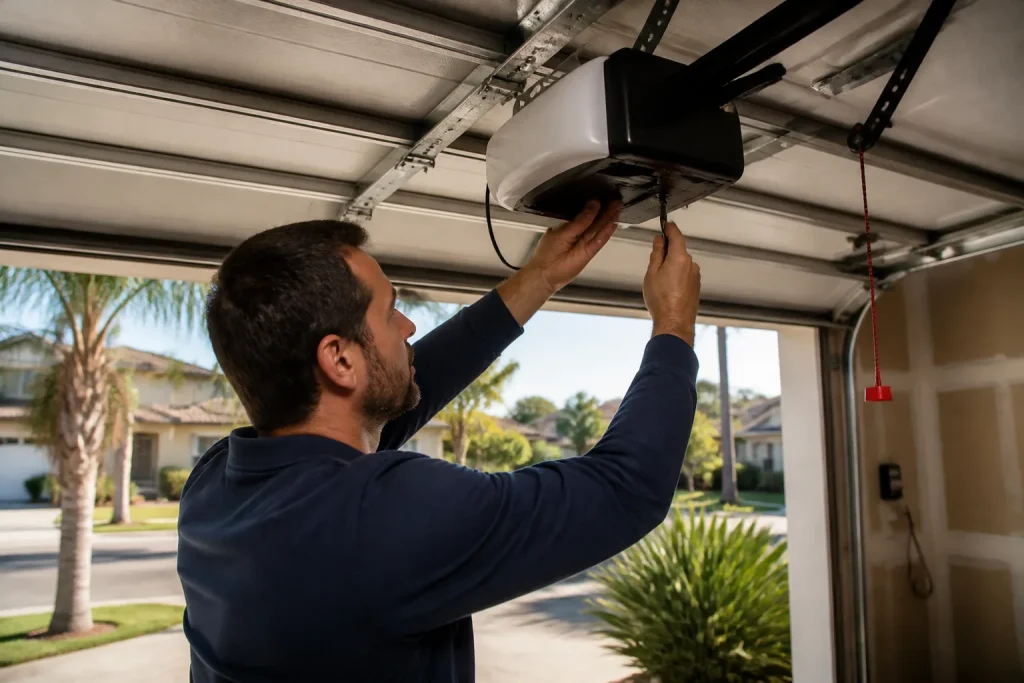
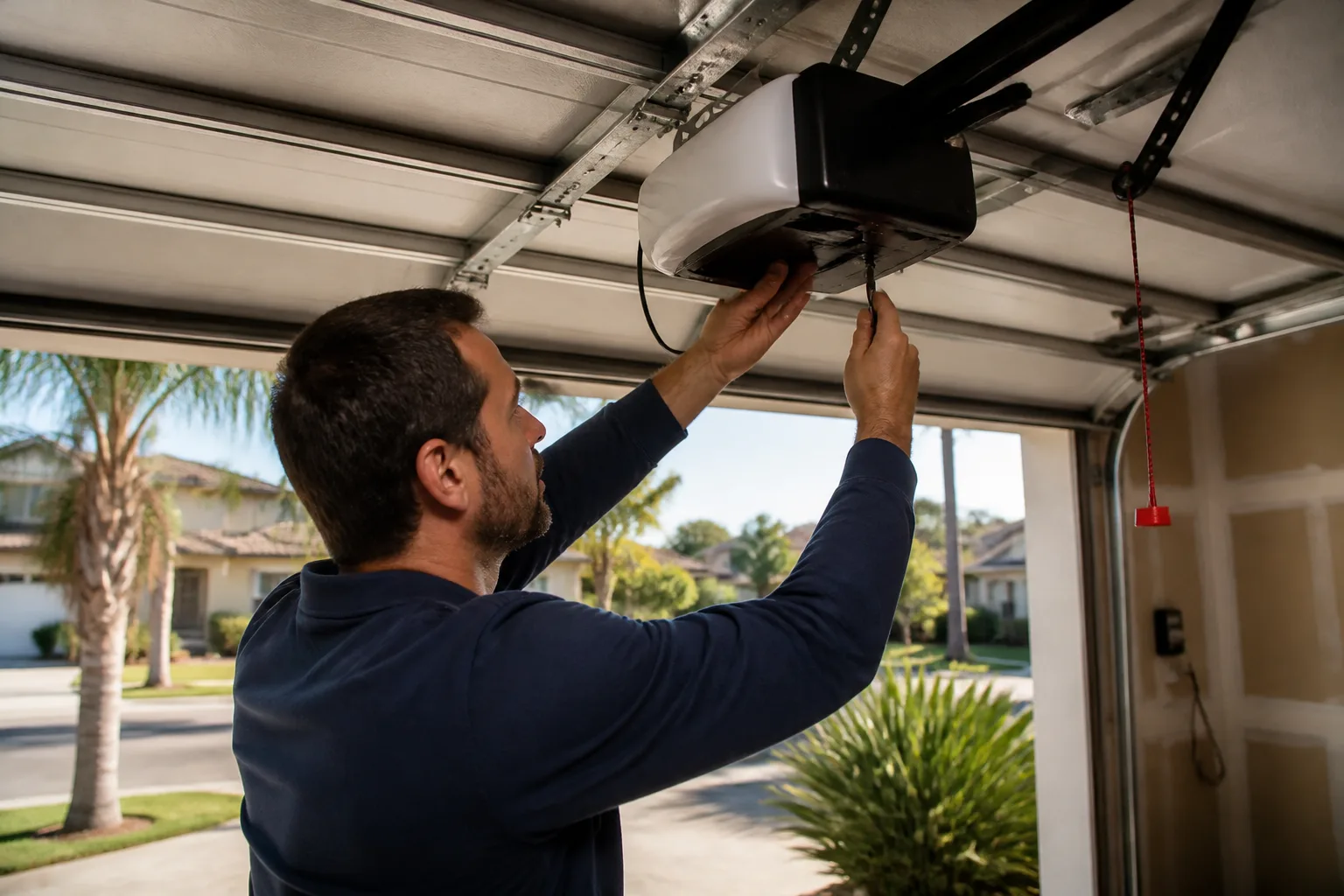
Garage Door Opener Repair: Repair or Replace? How Los Angeles Homeowners Decide
Most garage door opener failures come down to one of three components: the logic board, the drive system, or the motor capacitor. If your opener is under 12 years old and the repair costs less than half of a quality replacement, repairing is usually the smarter money. If the opener is past 15 years, the drive rail is worn, or the logic board has failed twice, replacement starts making more sense. Here’s the exact decision tree we use with homeowners across Los Angeles, from Silver Lake to Woodland Hills.
The average homeowner replaces a garage door opener at year 9, but the Department of Energy’s own data puts the functional lifespan of a properly maintained belt-drive opener at 12 to 15 years. That gap means millions of working units get landfilled every year based on a repair quote the homeowner had no way to evaluate. So let’s fix that. If you’d rather skip the diagnosis and talk to someone who does this every day, call (910) 858-8029 and we’ll walk you through it.
Key Takeaways
- Most opener failures trace to three components: logic board, drive system, or motor capacitor.
- Use the 50% rule: if the repair costs more than half of a quality replacement, replace it.
- Opener age alone is a weak signal. A 14-year-old Chamberlain with a fresh logic board can outlast a 4-year-old big-box unit installed poorly.
- Cheap replacements often cost more over five years than repairing a quality opener.
- In Los Angeles, a written pre-work estimate lets you compare both options on paper before committing.
Checkpoint 1: The Logic Board, the Brain of the Opener
The logic board is the circuit panel inside the motor housing that processes signals from your remote, wall button, and safety sensors. When it fails, the opener might click but not run, ignore remotes entirely, or open but refuse to close. In Los Angeles, where many homes date to the 1920s through 1960s, we regularly see logic boards fried by power surges from the city’s older grid infrastructure, particularly in neighborhoods like Highland Park and Echo Park where electrical panels haven’t been updated in decades.
Replacing a logic board runs between $150 and $280 on most LiftMaster, Chamberlain, and Genie units, including the service call. That’s a meaningful repair, but it’s not automatically a death sentence for the opener. A fresh logic board on a 10-year-old belt-drive unit can buy you another five or six years of service. We’ve seen this play out in Los Angeles constantly. A homeowner gets a quote for $220 to replace a logic board, panics, and buys a $300 opener from a big-box store. Then the installation turns out to be another $250 because the rail braces didn’t line up and the torsion spring needed to be rebalanced. Meanwhile, the old unit just needed a board.
Our rule at this checkpoint: if the logic board is the only fault and the opener is under 12 years old, repair it. If the board has failed once before and failed again within 18 months, something upstream is causing it, usually inconsistent voltage or moisture intrusion. That’s when replacement becomes the honest recommendation, and we’ll say so in writing before you spend a dollar.
Checkpoint 2: The Drive System, What Actually Moves the Door
The drive system is the mechanical assembly that moves the door along the rail. In a belt-drive opener, that’s a reinforced rubber belt running over a sprocket. In a chain-drive, it’s a metal chain. In a screw-drive, it’s a threaded steel rod. All three have one thing in common: they wear. And when they wear unevenly, the door starts to jerk, grind, or hesitate halfway through its travel.
Here’s the thing most Los Angeles homeowners don’t realize: drive system wear is almost always a symptom of a deeper issue. A door that’s slightly out of balance, or a torsion spring that’s losing tension, puts constant asymmetric load on the opener. The opener compensates, works harder, and tears itself apart slowly. We pulled a Chamberlain out of a garage in Sherman Oaks last month where the belt had worn through to the cords on one side. The opener was only six years old. The culprit was a spring that had been installed a half-size too small by a handyman. The opener was the victim, not the problem.
Replacing a worn belt, chain, or carriage assembly typically costs between $120 and $220 in the Los Angeles market. But here’s the fork in the road: if the drive system failed due to simple age, repair makes sense. If it failed because the door is unbalanced, repairing the drive system without fixing the underlying spring or track issue means you’ll be back in the same spot in twelve months. That’s not a guess. That’s a pattern we’ve corrected for hundreds of Los Angeles homeowners since 2001. At this checkpoint, the real question isn’t “can this be fixed?” It’s “why did it break in the first place?” A proper diagnostic should answer that before any parts get ordered.
Checkpoint 3: The Motor Capacitor, the Small Part That Stops Big Doors
The motor capacitor is a small cylindrical component inside the opener that stores and releases the electrical charge needed to start the motor. When it fails, the opener hums but doesn’t move, or it starts weakly and stalls halfway up. This is the single most misdiagnosed opener problem we encounter in Los Angeles, because the symptoms mimic a dead motor or a broken gear.
A capacitor replacement runs $90 to $140 on most brands. That’s one of the cheapest repairs in the garage door trade, and it’s also one of the most frequently skipped. Here’s why: a technician who doesn’t test the capacitor directly will often tell you the motor is seized and pitch you a full replacement. A new opener is a $450 to $700 ticket in Los Angeles, installed. A capacitor is $110. The incentive to misdiagnose is real, and it’s exactly why we put every finding in writing before any work starts. You shouldn’t have to take anyone’s word for it, ours included, without seeing the test result and the price side by side.
Our rule: if the opener hums but won’t run, test the capacitor first. It’s a five-minute diagnosis with a multimeter. If the capacitor is swollen, leaking, or reading below spec, replace it and re-test. More than half the time in our Los Angeles service area, that’s the entire repair. The motor was never dead. The owner was two service calls away from being talked into a new unit they didn’t need.
The Repair Ratio: How to Do the Math Yourself
Appliance economists use a simple formula called the repair ratio: the cost of the repair divided by the cost of a quality replacement. If that number is 0.5 or higher, meaning the repair costs at least half as much as replacing the unit, replacement usually wins. Below 0.5, repair is generally the better financial move. Here’s the version we teach Los Angeles homeowners:
- Repair cost under $150: almost always repair it, regardless of age. That covers capacitors, sensors, limit switches, and most drive-belt adjustments.
- Repair cost $150 to $300: repair if the opener is under 12 years old and the diagnosis is a single component failure. This is the logic board sweet spot.
- Repair cost over $300: this is usually a failed motor or a compounded failure of drive system plus logic board. At this point, the math tilts toward replacement, especially on openers over 10 years old.
But the 50% rule only works if you know what a quality replacement actually costs in Los Angeles. A cheap $179 opener from a big-box store, installed without proper force and limit calibration, will cost more over five years than a $300 repair on a quality Chamberlain or Genie. The cheap unit’s plastic gears strip. The force settings get left too high, which wears out the door springs early. The travel limits get set wrong, so the door slams or reverses unpredictably. By year three, you’re looking at $150 in corrective service calls plus a new spring at $200 to $350 because the old one got hammered. That’s the hidden cost of “cheap replacement,” and it’s the reason our written estimates in Los Angeles always show the repair price and the replacement price on the same sheet of paper. You compare them side by side, with no pressure and no verbal hand-waving.
Why Age Alone Is a Misleading Factor
A 14-year-old belt-drive LiftMaster with a fresh logic board and a properly balanced door will outlast a 3-year-old budget opener that was installed with the force settings maxed out. We see it every month in Los Angeles. Age tells you something about the opener. It doesn’t tell you anything about the installation, the maintenance history, or the condition of the door it’s attached to.
The components that actually signal end-of-life are specific. A motor that’s drawing amperage above spec even after the capacitor and drive system are ruled out. A chassis that’s visibly rusted through, which happens in coastal Los Angeles neighborhoods like Playa del Rey and San Pedro where salt air gets into everything. A logic board that’s been replaced twice. Those are the real end-of-life indicators. Not a number on a sticker.
Amarr and Clopay doors, which are common in Los Angeles, tend to be well-balanced from the factory. A properly balanced door means the opener does less work, which extends the drive system and the motor. The opener’s lifespan is never just about the opener. It’s about the whole system: door, springs, track, and opener working as one unit. That’s the lens we apply on every diagnostic call, because it’s the only lens that actually predicts what happens next.
When to Call a Pro
If you’ve run through the three checkpoints and you’re still unsure, or if the opener is making a grinding noise that’s getting worse, stop using it and call someone who can test the system properly. Garage door openers operate under tension, and a failing drive system or a broken spring under load can cause the door to drop without warning. That’s not a DIY moment. A trained professional has the tools to test capacitors under load, measure motor amperage draw, and check door balance with a tension scale. Most of what goes wrong with an opener in Los Angeles isn’t visible from the outside, which is why guessing costs more than testing.
If you’re in Los Angeles and want a written diagnosis with both numbers on one page, we’re easy to reach. We’ve been doing this since 2001, and every technician who arrives at your door will have already sent you their name and photo, verified their identity under the Threshold Standard, and shown you an ID badge before stepping inside. Related services in Los Angeles: Garage Door Opener Repair in Grandview, Garage Door Repair in Grandview, and Garage Door Installation in Grandview.
The Bottom Line
Repair your opener when the diagnosis points to a single component: a capacitor, a logic board, a worn belt, a limit switch. Replace it when the motor is failing, the logic board has failed multiple times, or the repair cost crosses half the price of a quality replacement properly installed. The decision isn’t about age charts or guesswork. It’s about testing the right three things in order, doing honest math on the repair ratio, and looking at both numbers in writing before you commit.
In Los Angeles, that’s exactly how we structure every opener diagnostic. The price is written down and handed to you before the first bolt is turned. The repair carries a 365-day guarantee: if it fails within a year, we come back and make it right at no charge, no argument required. If you’re trying to decide between repairing and replacing your garage door opener, call (910) 858-8029. We’ll test it properly, show you both numbers on paper, and let you make the call with both eyes open.
Frequently Asked Questions
Opener repairs in Los Angeles typically range from $110 for a motor capacitor replacement to $280 for a logic board replacement on a Chamberlain or Genie unit. Drive system repairs like a new belt or carriage assembly run $120 to $220. We quote every repair in writing before any work begins, so the number you see is the number you pay.
A quality belt-drive opener, like a LiftMaster or Chamberlain, installed with proper force calibration and limit settings, runs $450 to $700 in the Los Angeles market. The big-box $179 opener is a false economy once the installation issues and early component failures get factored in. A written estimate from us shows your repair price next to your replacement price so you can compare them honestly.
In most cases, yes. Our Los Angeles service area is covered by technicians who carry common parts on the truck, including capacitors, limit switches, and belts for Chamberlain, Genie, LiftMaster, and Clopay units. A live person answers our phone 24 hours a day, including weekends and holidays, so you won’t get a voicemail tree when you call (910) 858-8029.
No. The price we quote in writing is the price you approve before any work starts. If the diagnostic reveals something unexpected, we stop and show you an updated written price before touching anything else. That’s the Threshold Standard, and we’ve operated that way in Los Angeles since 2001. Call (910) 858-8029 for a free estimate.
Written by Aaron Teague, Owner at Doyle Garage Door Repair, serving Los Angeles since 2001.
Need Garage Door Help?
Call Doyle Garage Door Repair - licensed & insured, here with fast after-hours help in Los Angeles.
(910) 858-8029