
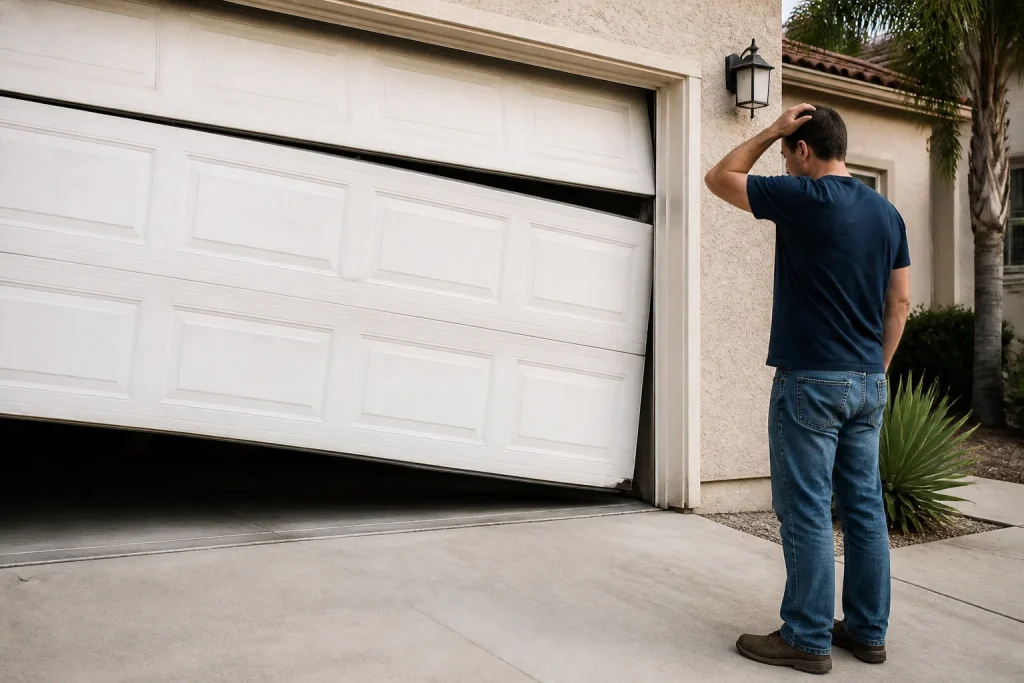
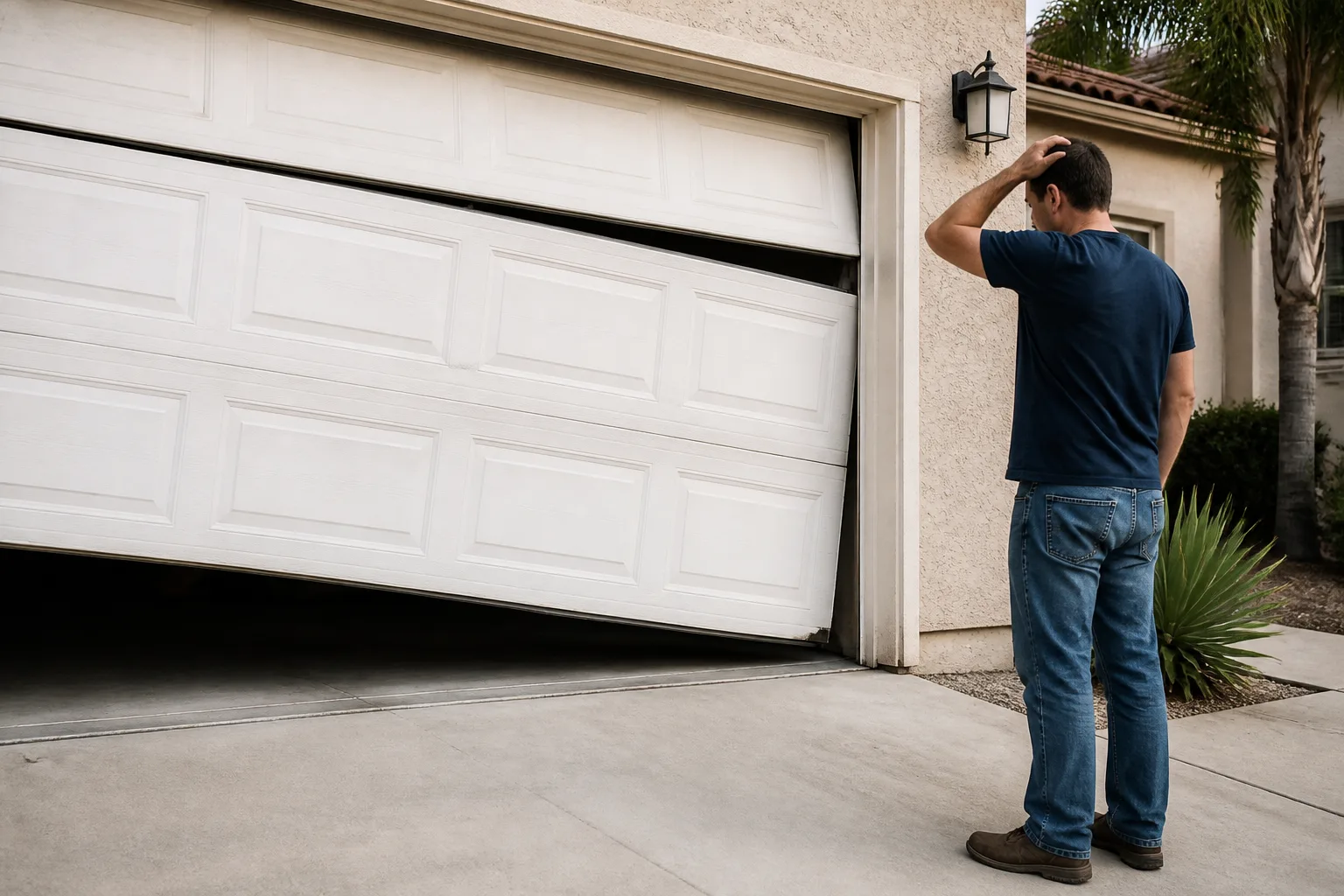
Top Signs You Need Garage Door Service – Don’t Ignore These
Most garage doors don’t fail without warning. They telegraph trouble for 30 to 90 days first, through symptoms quiet enough to dismiss until the morning the door won’t open and you’re late for work. The three signs that matter most are a door that moves slower than it used to, a door that sounds different than it did six months ago, and a door that sags or hangs unevenly when half open. If you’d rather not diagnose it yourself, call (910) 858-8029 and we’ll walk you through what you’re seeing.
Here’s the part most homeowners in Los Angeles don’t realize: a door that takes three seconds longer to close than it did last spring isn’t “getting old.” It’s likely a limit switch drifting out of calibration, the small component that tells your opener motor where to stop. Left uncorrected, that motor keeps pushing after the door has already reached the floor, overheats, and burns out. You’ve now turned a service call in the $95 range into a motor replacement that runs closer to $400. The warning was there. It was just easy to ignore.
The 90-Second Balance Test That Catches Spring Failure Early
Your garage door has a torsion spring, the large coil mounted horizontally above the door that does most of the lifting. When that spring starts losing tension, the opener motor compensates by working harder. That’s when you hear the strain and see the slowdown. But you can confirm a spring issue yourself in 90 seconds, safely, without touching the spring or the cables.
Here’s the test:
- Pull the red emergency release cord so the door operates manually.
- Lift the door to waist height, roughly halfway open, and let go.
- Watch what happens.
A healthy, properly balanced door stays put at the halfway point. It might drift an inch or two, but it holds. A door with a weakening spring drops quickly, sometimes hard enough to dent the track or damage the bottom seal. A door that flies upward on its own has the opposite problem: too much tension, which strains the spring and shortens its life. Either result means the spring needs professional adjustment. We adjust torsion spring tension using winding bars rated for the specific spring size, and this is one repair we tell every homeowner to leave alone, because a spring under load carries enough force to cause serious injury if it slips.
In Los Angeles, where temperature swings between coastal fog mornings and inland heat afternoons put constant expansion-and-contraction stress on metal components, we see spring wear accelerate faster than in more stable climates. Fall tends to be the highest-risk season, when the first cool nights arrive after a long hot summer and metal components contract. If your door fails the balance test in October, that’s not a coincidence.
What Those Sounds Actually Mean
Garage doors are noisy machines, but they’re noisy in specific, diagnostic ways. In our experience, most homeowners learn to live with sounds that are actually repair instructions. Here’s what each sound is telling you.
Grinding: This is almost always the rollers. Rollers are the small wheels that ride inside the vertical tracks on either side of the door. Nylon rollers wear down and then grind metal-on-metal inside the track. It’s a rough, gravelly sound that gets worse as the door moves. Replacing worn rollers typically costs under $150 and takes less than an hour. Ignoring the grind means the roller eventually seizes, the door jams mid-travel, and the opener motor strains against a door that won’t move. That’s a bigger bill.
Scraping: A high-pitched scrape, especially on one side, usually means the door edge is making contact with the track or the jamb. This can be a track misalignment from a loosened bracket, or it can mean the door itself has shifted on its hinges. Sometimes it’s as simple as a dry bottom seal dragging along the concrete. A technician can usually pinpoint a scrape in under five minutes with the door running.
Popping: A sharp pop while the door is moving often comes from a torsion spring that’s binding or a cable that’s slipping on its drum. This is the sound we take most seriously, because a cable that slips off its drum while under tension can snap, and a suddenly released cable becomes a dangerous projectile. If you hear any popping sound from the hardware above the door, stop using the door and call someone.
We’ve pulled failed components out of garages all over Los Angeles, from Mar Vista to Silver Lake, and the pattern is consistent: the homeowner heard the sound change weeks before the failure, assumed it was normal wear, and kept pressing the button.
The Visual Inspection You Can Do From the Floor
You don’t need a ladder to do a meaningful visual inspection of the two components most likely to fail without warning: cables and rollers. Both are visible from floor level when the door is closed.
Cables: Stand inside the garage with the door closed and look at the cables running vertically along each side of the door. You’re looking for three things. First, fraying, which looks like individual wire strands separating from the main cable, like a rope coming apart. Second, rust, which shows up as an orange-brown film or, worse, flaking. Third, slack, which means the cable isn’t taut against the drum when the door is closed. Any of these three means the cable is nearing failure.
Rollers: Look at the wheels inside the track. If you see flat spots worn onto the wheel surface, chips or cracks in nylon rollers, or a roller that’s sitting crooked in the track instead of square, that roller is done. Rollers are cheap insurance. Most garage door companies, including ours, install upgraded nylon rollers that are quieter and last longer than the builder-grade steel ones that came with the house.
One note on safety: checking cables and rollers from floor level with the door closed is safe. Attempting to remove a cable from its drum, or unbolting a bottom bracket while the spring is under tension, is not. Those jobs require winding bars, cable tension releases, and the experience to know what the tension is doing at every step. If your floor-level inspection shows fraying, rust, or flat-spotted rollers, the right move is to stop using the door and get a professional there.
Why a Door That Reverses Before Touching the Ground Is Rarely an Opener Problem
This is the misdiagnosis we hear most often. A homeowner’s door starts reversing before it reaches the floor, so they assume the opener is failing and start shopping for a replacement. In our experience in Los Angeles, the problem is usually not the motor. It’s either the safety sensors or the limit switch.
The safety sensors are the two small units, one on each side of the door opening, mounted about six inches off the floor. They shoot an invisible beam between them. If the beam gets interrupted, the door reverses on the assumption that a child or pet is in the way. A sensor knocked out of alignment by a broom, a bike, or a trash can will break the beam and trigger the reversal, even though nothing is actually in the path. Most of the time, one sensor has simply been bumped a fraction of an inch and the indicator light has gone from solid green to blinking. That’s a five-minute adjustment, not a new opener.
The limit switch is a different issue. It’s the setting that tells the opener how far down the door should travel. When it drifts, the door believes it has reached the floor before it actually has, and reverses course. This is the three-seconds-longer-to-close scenario from earlier. A technician recalibrates the limit switch with a flathead screwdriver in about ten minutes. Compare that to the cost of a new opener from LiftMaster or Genie, which with installation runs anywhere from $450 to $900 depending on the model, and you see why rushing to replace the opener is the expensive version of the diagnosis.
If your door reverses before it touches the ground, check the sensor lights first. If one is blinking, realign it. If both are solid but the door still reverses short, it’s likely the limit switch. Either way, an accurate diagnosis costs less than the wrong repair.
Grandview and the North Texas Climate: Why Fall Is the Highest-Risk Season
Temperature affects metal. That’s true everywhere, but in North Texas, the swings are aggressive. A summer afternoon in the high 90s followed by a nighttime drop of 30 degrees puts real stress on torsion springs, cables, and even the metal track sections that expand and contract at slightly different rates. By fall, components that spent the summer under heat-expanded tension are contracting into cooler-weather positions, and any fatigue in the metal shows up then.
For our readers in Grandview and the surrounding area, that means October and November are the months when spring failures spike. The local soil also plays a role: clay-heavy soil expands and contracts with moisture, which shifts concrete slabs, which shifts garage door frames, which knocks tracks out of alignment. A track that was perfectly square in June may be binding in November because the slab moved a quarter inch. None of this means your door is doomed. It means fall is the smart time for a professional inspection, before the first cold snap turns a minor misalignment into a snapped cable.
We also see a seasonal pattern in our Garage Door Repair in Grandview calls: every November, the first week of cold weather brings a cluster of homeowners who’ve ignored a stiffer-than-usual door for months. The door worked, until it didn’t.
When to Call a Pro (and When You Can Handle It Yourself)
Some jobs on a garage door are genuinely DIY-friendly. Lubricating hinges, rollers, and the torsion spring with a white lithium or silicone-based spray is a ten-minute task you can do seasonally. Tightening loose bolts on the track brackets with a socket wrench is safe, as long as you stay away from the bolts on the spring’s center bracket, which are under load. Checking sensor alignment and cleaning dust off the sensor lenses takes two minutes.
Other jobs are not DIY-friendly. Torsion spring replacement is at the top of that list. The spring holds the weight of the door, often 150 to 300 pounds of tension, and if a winding bar slips during installation or removal, that force releases instantly. It’s the most common cause of serious garage door injuries. Cable replacement is second, because removing a cable requires releasing tension from the spring first, in the right order, with the right tools. If the job involves the spring, the cables, or the bottom brackets where the cables attach, it belongs with a trained technician.
If you’re in Grandview and your door is showing any of the signs above, Doyle Garage Door Repair has served the area since 2001 as part of the Threshold Group family of home-service companies. Every technician we send is background-checked and identity-verified under the Threshold Standard, and you get the name and photo of your technician before they arrive. The price for any repair is written down and handed to you before we turn a single bolt. And every repair carries our 365-Day Done Right Promise: 365 days from the date of repair, if it fails, we come back and make it right at no charge. If you’re near Doyle Garage Door Repair home service area, we also handle Garage Door Installation in Grandview and Garage Door Opener Repair in Grandview.
The Bottom Line
Here are the takeaways that matter. A slowing door is usually a spring losing tension or a limit switch drifting, not normal aging. A grinding sound is rollers wearing flat, and it gets more expensive the longer you wait. A popping sound from the hardware above the door means something is binding under tension, and you should stop using the door immediately. A door that reverses before touching the ground is usually a sensor misalignment or a limit switch issue, not a dead opener. And in Grandview’s clay-shifting, temperature-swinging climate, the highest-risk season for spring and cable failure is fall, right now.
If you’re in Los Angeles or Grandview and any of these signs sound familiar, call (910) 858-8029 for a free estimate. A real person answers, day or night, weekends and holidays included.
Frequently Asked Questions
A torsion spring replacement in Grandview typically runs between $180 and $340 depending on the spring size and whether it’s a single or double-spring configuration. It’s the most common repair we do, and most jobs are completed the same day. Call (910) 858-8029 for an exact quote – estimates are free, and the price you’re quoted is the price you pay.
Yes. In most cases we’re able to get a technician to a Grandview home the same day you call, especially for spring failures, snapped cables, and doors that won’t open. The price is written down and agreed to before any work begins, so there’s no surprise when the job is done. If you’re dealing with a door that’s stuck open or stuck closed, call us now and we’ll tell you exactly when we can be there.
No. That’s the entire point of our no-hassle upfront pricing. The quote we write down for you, before any work starts, is the price you pay. If the technician finds something additional during the repair, you’ll get a separate written price for that work before it’s started. There’s no pressure and no bill you didn’t approve.
Before your appointment, we send you the name and photo of the technician who’s coming. When they arrive, they’ll be in a clean, marked uniform and carrying a photo ID badge. They’ve been background-checked and identity-verified under the Threshold Standard. The person in the photo is the person at your door. No exceptions, every time.
Our trucks are stocked with the most commonly replaced parts: torsion springs in multiple sizes, cables, rollers, hinges, sensors, and opener components for LiftMaster, Chamberlain, Genie, Craftsman, Wayne Dalton, and Raynor models. That means most repairs are completed in a single visit, not scheduled for a second trip. Call (910) 858-8029 and we’ll confirm we have what your door needs.
Written by Aaron Teague, Owner at Doyle Garage Door Repair, serving Los Angeles since 2001.
Need Garage Door Help?
Call Doyle Garage Door Repair - licensed & insured, here with fast after-hours help in Los Angeles.
(910) 858-8029