
How to Choose the Right Garage Door Company in Los Angeles
Choosing the right garage door company in Los Angeles comes down to three verifiable commitments: a written price before work begins, a labor-and-parts guarantee in writing, and technician transparency that tells you exactly who is showing up before they arrive. Most companies won’t put all three in writing, and that’s the filter that separates serious operators from everyone else. If you’d rather skip the research and just get a straight answer, call (910) 858-8029 and we’ll walk you through it.
The Texas Department of Licensing and Regulation (TDLR) requires garage door technicians to hold a specific license, yet a 2023 review of local listings found a significant share of companies operating in smaller Texas markets list no license number anywhere on their site. Los Angeles homeowners rarely think to check, and that’s exactly what the bad operators count on.
Verify the TDLR License Before You Book Anyone
Every legitimate garage door company in Los Angeles must carry a TDLR-issued license for garage door installation and repair work. The number is public record, searchable on the TDLR website, and takes under 60 seconds to verify. You type in the company name or license number, and the state database tells you whether the license is active, expired, or nonexistent.
Here’s the process we recommend:
- Ask the company for their TDLR license number on the phone. If they hesitate, that’s your first warning sign.
- Go to the TDLR license search page and enter the number.
- Confirm the name on the license matches the name on the truck and the invoice.
- Check the license status. Active means they’re current. Anything else means you keep looking.
In our experience, a company that won’t volunteer its license number is telling you something before you ever open the door. The reputable shops in Los Angeles print the number on the side of the truck and the top of the estimate. A missing license number isn’t an oversight. It’s a business decision.
Written Price vs. “Free Estimate”: Know the Difference
A free estimate is a verbal number tossed out before anyone climbs a ladder. It protects the company, not you. A written price is a fixed dollar amount on paper, handed to you before a single bolt is turned. The difference matters because dispatch fees, diagnostic fees, and surprise labor charges all live in the gap between “we can probably do it for around…” and what the final invoice says.
When you call a garage door company in Los Angeles, ask one question: “Will you put the price in writing before any work starts?” If the answer is no, or if they say they’ll “get you a number once we’re out there,” you’re setting yourself up for a pressure decision with a technician standing in your driveway.
At Doyle Garage Door Repair, the price is written down and handed to the customer before we touch a single spring, cable, or panel. No verbal estimates. No invoice surprises. The number you see is the number you pay, and it includes labor, parts, and tax. You agree to it first, then we work.
This policy matters most on larger jobs. A torsion spring repair in Los Angeles typically runs $180 to $340 depending on spring size and cycle rating. A new LiftMaster opener installation usually lands between $450 and $700. A company that won’t commit to those numbers in writing is a company that’s comfortable charging you more once the door is in pieces on the floor.
The Parts Warranty vs. Labor-and-Parts Guarantee: Why It Costs You Money
Most garage door companies in Los Angeles offer a “parts warranty.” That means the manufacturer covers a defective spring or opener, but you pay for the labor to remove the old part and install the replacement. Labor is often the larger share of the bill, so a parts-only warranty leaves you paying $150 to $250 out of pocket for a part that failed through no fault of yours.
A labor-and-parts guarantee covers both. If the repair fails within the guarantee period, the company comes back, removes the failed part, installs the replacement, and you owe nothing. No diagnostic fee, no service call charge, no argument about whether the failure was “covered.”
Here’s where Los Angeles homeowners lose money every month: a torsion spring rated for 10,000 cycles (roughly 8 to 10 years of normal use) fails early because it was installed improperly or undersized. The parts warranty covers the $60 spring. The labor to swap it is on you. A labor-and-parts guarantee would have covered both.
Our guarantee is stated in exact terms every time: 365 days from the date of repair. If it fails, we come back and make it right at no charge. The second visit is free, automatically, with no argument required. Every repair gets this guarantee in writing, included at no extra charge. No fine print about “normal wear” or “acts of God.” If we fixed it and it broke within a year, we own it.
Technician Transparency: What “Name and Photo Before Arrival” Actually Signals
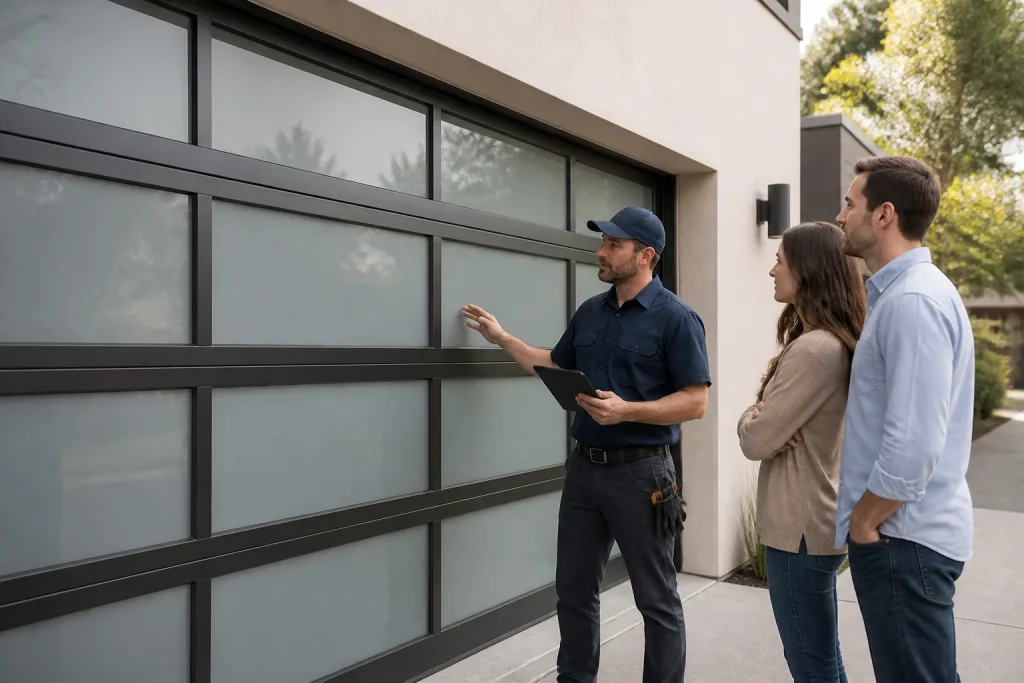
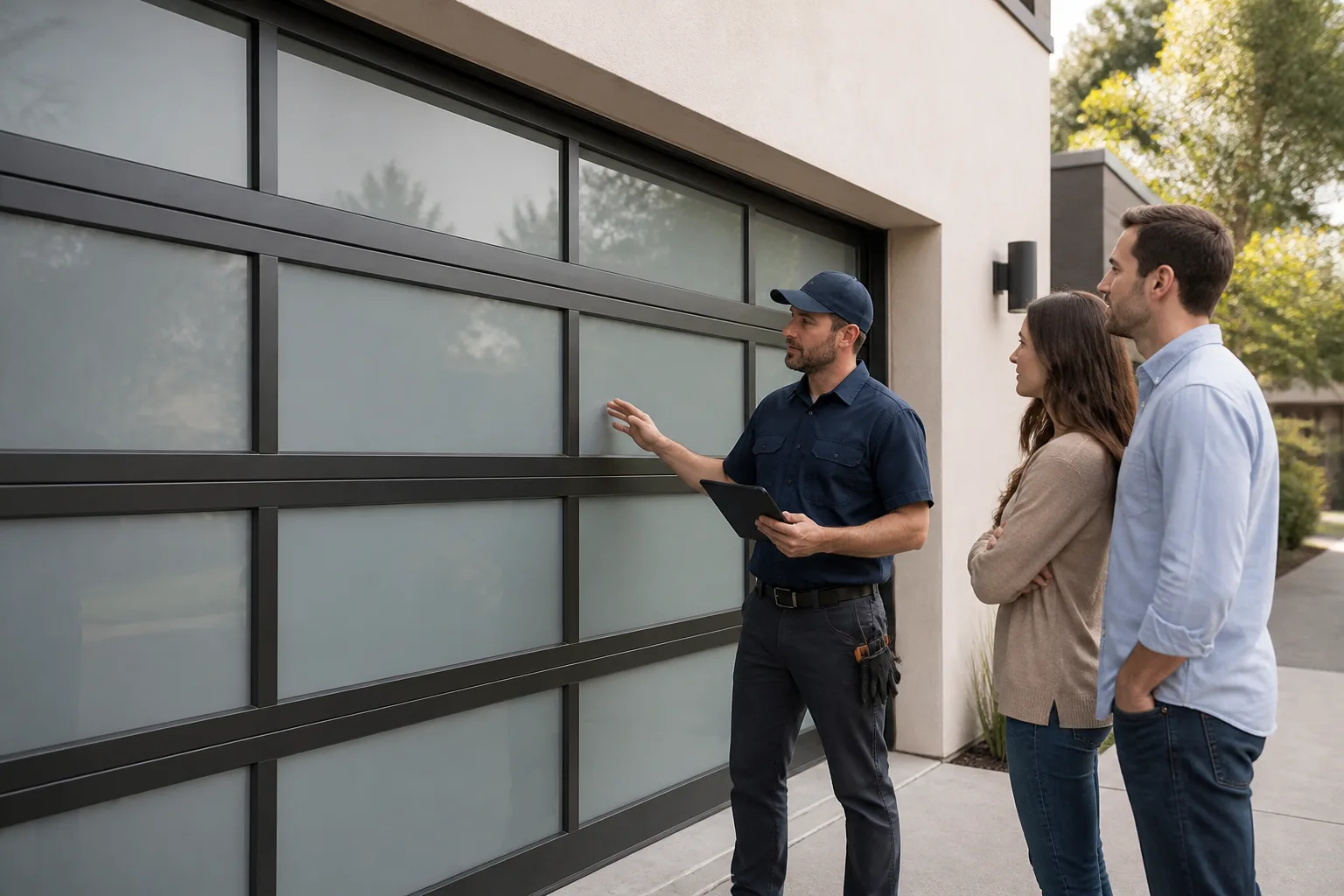
Homeowners who are home alone, parents with young children, and older homeowners understand something the garage door industry has ignored for decades: opening your door to a stranger is a legitimate safety decision, not a social courtesy. A company that sends you the technician’s name and photo before the visit is telling you something important about how it operates. It means the company has enough confidence in its people to put their identity in your hands before they stand on your porch.
Ask any garage door company in Los Angeles this question: “Who’s coming to my house?” If they say “one of our techs” or “you’ll see when they get there,” that’s an operating standard. If they say “his name is Aaron, here’s his photo and badge,” that’s a different operating standard entirely.
Every Doyle Garage Door Repair technician is background-checked and identity-verified under the Threshold Standard, which is the verification process we built in 2001 and still run today. Before every visit, you get the technician’s name and photo. When they arrive, they’re in a clean, marked uniform and they show a photo ID badge at the door. No exceptions, no substitutes, no “the tech who was supposed to come called out.” The person in the photo is the person at your door.
This isn’t a gimmick. We started sending names and photos because a customer in Los Angeles told us she had stopped using garage door companies entirely after a bad experience with a contractor who wouldn’t identify himself. She wanted to know who she was letting in. So we built a system around answering that question before she had to ask it.
Red Flags in Online Reviews: Seeded Ratings vs. Earned Ones
The garage door industry in Los Angeles has a review problem. Some companies seed their own ratings with fake reviews or pressure customers into posting five stars before the truck has left the driveway. Others buy reviews in bulk. Figuring out which Google stars are real takes about ten minutes of reading.
Here are the red flags we tell people to look for:
- Clusters of five-star reviews with identical phrasing. Real customers don’t all say “prompt, professional, and courteous” in the same order.
- Reviews posted in bursts. A company that gets 40 five-star reviews in one week and nothing for the next six months is likely seeding.
- Five-star reviews that mention nothing specific. “Great company, would recommend” tells you nothing. Real reviews mention the spring that broke, the opener that got installed, the neighborhood the house is in.
- No negative reviews at all. Even the best garage door company in Los Angeles will occasionally get four stars. A perfect 5.0 with hundreds of reviews is statistically improbable.
- Reviews that read like ad copy. If the review mentions the company’s marketing slogan or lists every service they offer, it was written by someone who works there.
Read the three-star and four-star reviews. Those are the honest ones. A four-star review that says “great repair, but they showed up an hour late” tells you the company does good work but runs behind schedule. That’s useful. A five-star review that says “best garage door company in Los Angeles, they’re the best, five stars, highly recommend” tells you nothing except that someone wanted to post a review fast.
What to Ask Before You Book: A Five-Call Checklist
If you’re comparing garage door companies in Los Angeles right now, here’s the script. It takes five minutes per call and it’ll eliminate most bad operators before you’ve given anyone your address.
- “What’s your TDLR license number?” They should have it memorized or on the phone immediately.
- “Will you put the price in writing before any work starts?” A yes is mandatory. A no is a hang-up.
- “Does your guarantee cover labor and parts, or just parts?” Both means both. Just parts means you’ll pay labor on a warranty claim.
- “Will you send me the technician’s name and photo before they arrive?” This one separates the professional operators from the call-dispatch-and-pray model.
- “Who answers the phone at 9 p.m. on a Saturday?” If it’s a voicemail tree or a callback form, that’s what you’ll get when your spring breaks at 8 p.m. on a Friday.
We pulled a broken spring out of a garage in Los Angeles a few months back that had been “repaired” by another company four weeks earlier. The spring they installed was rated for 10,000 cycles but it was the wrong wire size for the door weight. It wore out in a month. The customer called the original company, and they told her the parts warranty covered the spring but not the $195 labor charge to install a new one. She called us instead. We fixed it under our 365-day guarantee, except the guarantee had nothing to do with us being the ones who failed. It was just the right thing to do, and she’s been a customer ever since.
When to Call a Pro Instead of Researching
There’s a point in every garage door problem where research stops helping and a phone call starts helping. If the door is off its tracks, if a cable is frayed, or if the torsion spring – the large coil mounted above the door that does most of the lifting – has snapped, don’t try to diagnose it yourself. High-tension springs and cables can cause serious injury if handled wrong. A trained technician knows how to release that tension safely and inspect the full system in about 30 minutes.
If your door is making grinding noises, moving unevenly, or the opener hums but won’t move the door, call us at (910) 858-8029. A live person answers, day or night, weekends and holidays. Not a voicemail tree, not a bot, not a callback form. You’ll know exactly who’s coming before they arrive, and the price will be in your hands before any work begins.
We handle garage door repair, new door installation, and opener work for homes across Los Angeles. If you’re comparing companies right now, start with the five questions above. Most of the companies you call won’t pass all five. We do, and we’ve been doing it since 2001.
The Bottom Line
Choosing the right garage door company in Los Angeles isn’t about who has the most Google stars. It’s about three commitments every legitimate company will make in writing and most won’t: a written price before work starts, a labor-and-parts guarantee on every repair, and technician transparency that tells you exactly who is coming to your door before they arrive. Verify the license, read the middle-star reviews, and ask the five questions. The company that passes all of them is the one you hire.
If you’re in Los Angeles and need help with a repair, installation, or opener issue, Garage Door Repair in Grandview is available today. For a new door, see Garage Door Installation in Grandview. Opener acting up? Check out Garage Door Opener Repair in Grandview. Doyle Garage Door Repair offers free estimates, call (910) 858-8029.
Frequently Asked Questions
Ask for the TDLR license number, then search it on the Texas Department of Licensing and Regulation website. The license should be active and the name should match the company on the invoice. Legitimate companies print the number on trucks and estimates. If a company won’t provide it, find a different company. For a specific recommendation in Los Angeles, call (910) 858-8029 and we’ll walk you through the verification process.
A torsion spring repair typically runs $180 to $340 depending on spring size and cycle rating. A new LiftMaster, Chamberlain, or Genie opener installation usually lands between $450 and $700 including labor. New door installation varies widely by material and size; expect $800 to $3,500 for most Los Angeles homes. Always get the price in writing before work starts so the invoice matches the quote. Call (910) 858-8029 for an exact number on your specific door.
Most companies cover parts only, meaning you pay for labor when a part fails under warranty. A labor-and-parts guarantee covers both, so a failed spring or opener gets replaced at no charge to you. At Doyle Garage Door Repair, every repair includes a 365-day written guarantee that covers labor and parts. If it fails within a year, the second visit is free, automatically, with no argument required.
Not with a company that provides written pricing. The price should be put in writing and agreed to before any work begins. If a company says they’ll “finalize the number once we’re out there,” you’re exposed to dispatch fees, diagnostic fees, and surprise labor charges. Every job we do includes a written price handed to the customer before a single bolt is turned. Call (910) 858-8029 and ask us to put it in writing, we will.
Written by Aaron Teague, Owner at Doyle Garage Door Repair, serving Los Angeles since 2001.
Need Garage Door Help?
Call Doyle Garage Door Repair - licensed & insured, here with fast after-hours help in Los Angeles.
(910) 858-8029